Iridium Deployed is a video series highlighting real-world applications of Iridium Connected™ devices & services.
Solar storms can disrupt the aviation industry, terrestrial-based telecommunications, satellite systems, and even power grids—but scientists at the Johns Hopkins University Applied Physics Laboratory (APL) continue to study ways to mitigate their impact.
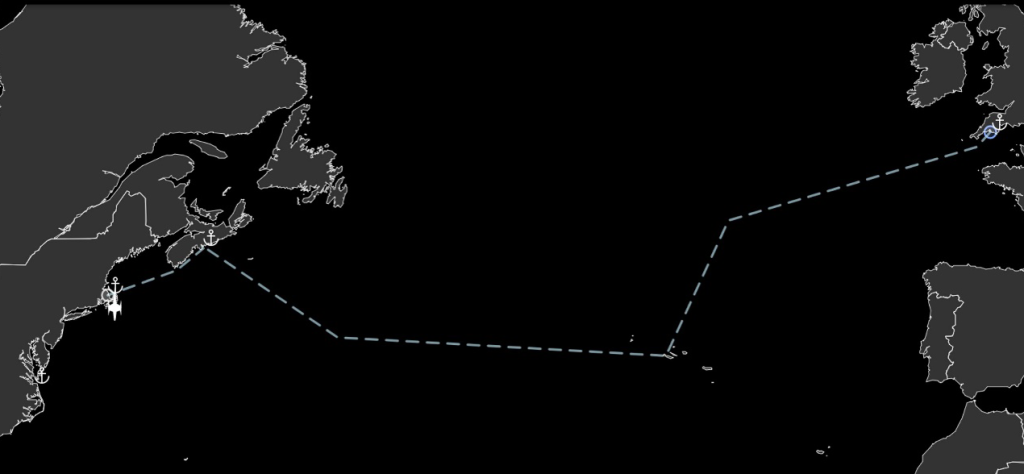
The Mayflower Autonomous Ship (MAS) began its journey on April 27, 2022, when it departed—like its 17th Century namesake–from Plymouth, England. The Uncrewed Surface Vessel (USV) then embarked on a 3,500 nautical mile journey across the Atlantic Ocean, with the aim of recreating the sailing ship’s landing destination at Plymouth Rock in Plymouth, Massachusetts.
Despite several unscheduled stops due to ship operating technical issues, the MAS managed to successfully arrive at port on June 30, 2022.
Map detailing the Mayflower Autonomous Ship’s journey from Plymouth, England, to Plymouth, Massachusetts, USA.
AI Captain Steering The Ship
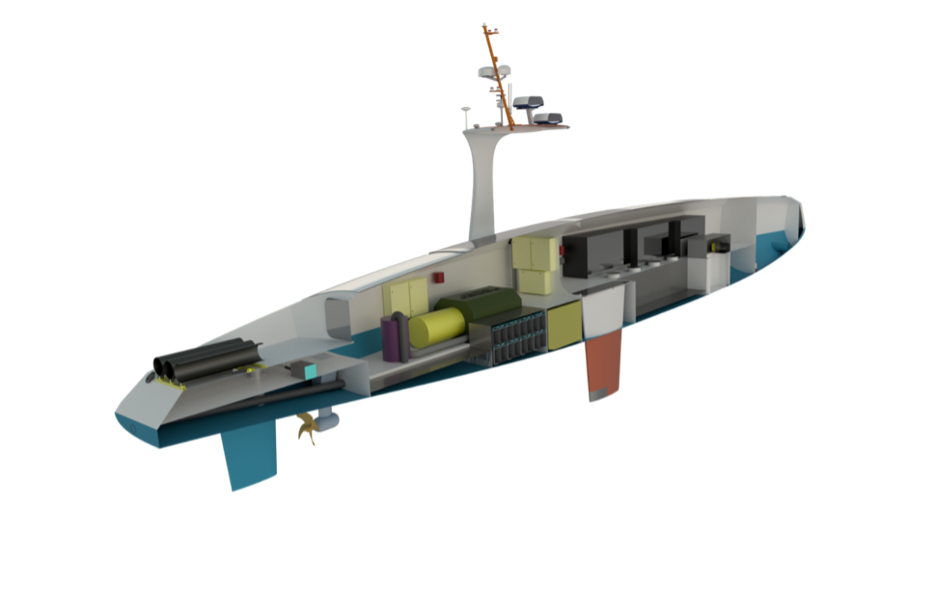
Developed by Promare and IBM, the MAS was packed with an array of scientific instrumentation designed to push the limits of possibility. One of the most popular and intriguing instruments was HyperTaste, an electronic tongue that “tastes” seawater to evaluate ocean health.
With a complex Artificial Intelligence (AI) capability powered by IBM’s AI engine Watson—cleverly renamed AI Captain for the MAS voyage—the uncrewed vessel was designed to sail across the ocean without human intervention.
“We used a number of data sets to train the AI engine and make it self-sufficient,” said Brett Phaneuf, CEO of Promare. “Despite having a human in the operational loop for MAS, AI Captain performed extremely well and rarely required the team’s intervention. AI Captain would alert us if there was another vessel nearby or a significant event occurring. For example, we had several curious fishing vessels watching the MAS, plus the four full high-definition cameras observed a few dolphins. Otherwise, it was boring.”
“We intended for the MAS to operate offline, thinking that we wouldn’t have access to high-speed data. Therefore, we employed edge processing capabilities onboard to firstly perform decision making and secondly to significantly reduce the amount of data transferred over the air,” said Don Scott, CTO of Promare. “Having the ability to push updates to the MAS over the air and manage both the software containers and computer resources gave a new dimension of remote management.”
Enthralling MAS Viewers Globally
The success of the MAS depended on several companies across different sectors collaborating to find solutions. One of the most beloved features of the MAS voyage was the MAS400 video stream.
“The public loved to engage with the MAS, viewing both its cameras and telemetry. We had hundreds of thousands of views of the MAS cameras during the transatlantic voyage – the public felt part of this unique journey,” Phaneuf said.
Typically, video streaming requires heavy bandwidth that quickly consumes lots of data, restricting its use to specific scenarios, but Iridium partner Videosoft managed to efficiently deliver the MAS400 video stream through its video compression software technology.
VideoSoft is a leading provider of advanced video compression technologies that enable efficient, high-quality video transmission over low-bandwidth networks. Their video compression engine can even operate on low-power, single-board computers, (e.g., Raspberry Pi or Jetson Nano) that are typically already installed onto uncrewed vessels. This reduces the data that need to be transmitted, freeing up bandwidth and reducing latency.
“The VideoSoft encoders were able to simultaneously transmit several real-time video streams over Iridium Certus,” said Stewart McCone, CEO of VideoSoft. “Our highly efficient, real-time video compression provided a new level of situational awareness and allowed the public to view the MAS’s journey.” The server allowed the MAS team to focus on one video stream of interest, enabling significantly higher resolution and frame rates essential for operational decision making.
“There is a perception that high bandwidth is required for video transmision. The reality is that our compression engine will operate down to 4 Kbps per second link. Therefore, the 352 Kbps uplink from the [Thales] VesseLINK 700 was more than sufficient for our video requirements,” McCone said.
The Maritime Autonomous Revolution
“We are just at the start of the autonomous and USV revolution,” said Wouter Deknopper, Vice President & General Manager of Maritime for Iridium. “USVs are regularly performing automated tasks that were previously very labour intensive, reducing the time for project delivery and carbon impact on the environment. The MAS project has become the gold standard in USV operation, demonstrating that [Beyond Line of Sight] BLOS operation of an asset is enabled by Iridium Certus. Incorporating edge processing techniques and efficient video compression enables USV operators to push their boundaries beyond what they thought was possible.”
Continued Contributions to Ocean Sciences
After completing its original purpose, the MAS continues to do important scientific work in the United States. The vessel has performed several research missions for multiple organizations including the Woods Hole Oceanographic Institute, providing critical information on the health of our oceans and the life within them. Promare and their sister company MSubs continue to build other USVs and autonomous vessels for multiple deployments.
“Our experience from the MAS continues to drive innovation both within M-SUBS and in the wider USV community,” Phaneuf said. “Iridium Certus is a critical piece of our autonomous jigsaw, enabling BLOS operation for our future assets and allowing us to push the boundaries of what’s possible.”
Among the segments that make up the aviation market, commercial aviation is one of the largest and fastest growing. According to a report by Allied Market Research, the commercial aircraft market size is projected to reach $192.76 billion in value by 2030. With commercial aircraft transporting people and goods across the entire planet, reliable communications technology, especially satellite communications (SATCOM) solutions are a must.
So, buckle your seatbelts and put your seat backs in the upright position, it’s time to learn about how Iridium® SATCOM keeps commercial aircraft connected.
What Is Commercial Aviation?
Think big-name commercial airliners that transport people and goods from point A to point B. These aircraft require robust connectivity onboard that can enable critical communications for pilots in the cockpit, flight crew members, aircraft telematics and safety applications. Iridium has been a leader in the industry for over a decade and has worked alongside global regulators including the International Civil Aviation Organization (ICAO), the Federal Aviation Administration (FAA), Airlines Electronic Engineering Committee (AEEC), Systems Architecture and Interfaces Subcommittee (SAI), and the International Telecommunication Union (ITU) to set carriage requirements and standards.
For commercial aviation, Iridium offers many unique benefits. Iridium is the only interconnected satellite network that covers the entire planet with reliable, L-band satellite connectivity (including the polar regions), making communications possible across the global airspace, from any altitude and even during adverse weather conditions. The solutions for commercial aircraft feature low-gain, lightweight antennas that are solid state and utilize either electronic steering or omnidirectional technology – depending on your ‘need for speed’ – all of which makes for highly competitive options in comparison to other connectivity providers. Iridium solutions create a very small footprint and induce far less parasitic drag on the aircraft, helping cut down on fuel costs. Additionally, they are built using an industry-standard bolt pattern that simplifies installation. The terminals are available through a wide range of industry-leading manufacturers, offering end users choice and diversity of suppliers.
Now that we’ve covered the background information, let’s (sky)dive into the four main ways Iridium connects commercial aircraft.
Cockpit SATCOM
This technology is primarily data-driven and supports non-safety applications like aircraft operations and flight information, including graphical weather data, flight plan updates and navigation chart and terrain database updates to be quickly shared with ground operations.
Flight Crew Communications
In addition to the cockpit, Iridium connects the crew. With these services, crew can make voice and data calls and critical in-flight group operations, such as passenger list management, in-flight credit card processing, inventory restocking, logistics management and equipment malfunction alerting. Crew members are also able to make emergency calls for telemedicine purposes.
Aircraft Monitoring
While monitoring aircraft location in the sky is extremely important, it is also crucial to monitor what is happening within the aircraft itself. Iridium enables connected aircraft technology that gives flight crew members and ground operators the ability to track the health of an aircraft through system monitoring and maintenance applications. Operators can see which parts need maintenance and can intervene at the next destination. This ability to conduct proactive and preventative maintenance can greatly increase in-flight efficiencies and cut down costs.
Aviation Safety
Here is where Iridium sets itself apart from the pack, but it’s also where things get a bit complicated. With this in mind, we did our best to keep it short and simple. Iridium satellite communications enable a number of safety services for aircraft, many of which are required by regulatory authorities.
Aeronautical Mobile Satellite (Route) Service (AMS(R)S)
AMS(R)S is a globally regulated aviation safety service. It is comprised of both voice and data services enabling communication between aircraft and Air Navigation Service Providers (ANSPs), also known as air traffic control.
The voice component is called Air Traffic Service Safety Voice (ATS Safety Voice) and the data component is called Future Air Navigation Service (FANS).
ATS Safety Voice
Iridium ATS Safety Voice operates under requirements and guidelines set by ICAO and ensures that these safety-related voice calls are prioritized over all other voice and data communications.
FANS
FANS, which is only used for remote, oceanic and polar operations, is comprised of two kinds of data messages – Automatic Dependent Surveillance-Contract (ADS-C) and Controller-Pilot Datalink Communication (CPDLC).
ADS-C messages send a “here I am” message from the aircraft to the ANSP. These messages contain position information and can be sent at predetermined intervals automatically or by request of the ANSP.
CPDLC messages contain operational information and communicate information such as departure clearances, flight path changes, re-routes and weather information. CPDLC helps make air traffic management more efficient by reducing the overall need for voice communication with air traffic control.
Today, Iridium is used for safety operations on thousands of aircraft today from business jets to Airbus and Boeing aircraft, as well as global cargo operators enabling the safe delivery of people and goods.
Looking ahead, Iridium is working to introduce Aeronautical Telecommunication-Open Systems Interconnection (ATN/OSI) and Aeronautical Telecommunications-Internet Protocol Suite (ATN/IPS) services. ATN/OSI, an inter-network architecture that allows ground/ground, air/ground, and avionic data subnetworks to interoperate by adopting common interface services and protocols, is based on Open Systems Interconnection and has been adopted to aviation applications. The more efficient ATN/IPS is based on modern Internet Protocol (IP), and Iridium Certus® is targeted to support these services in the future.
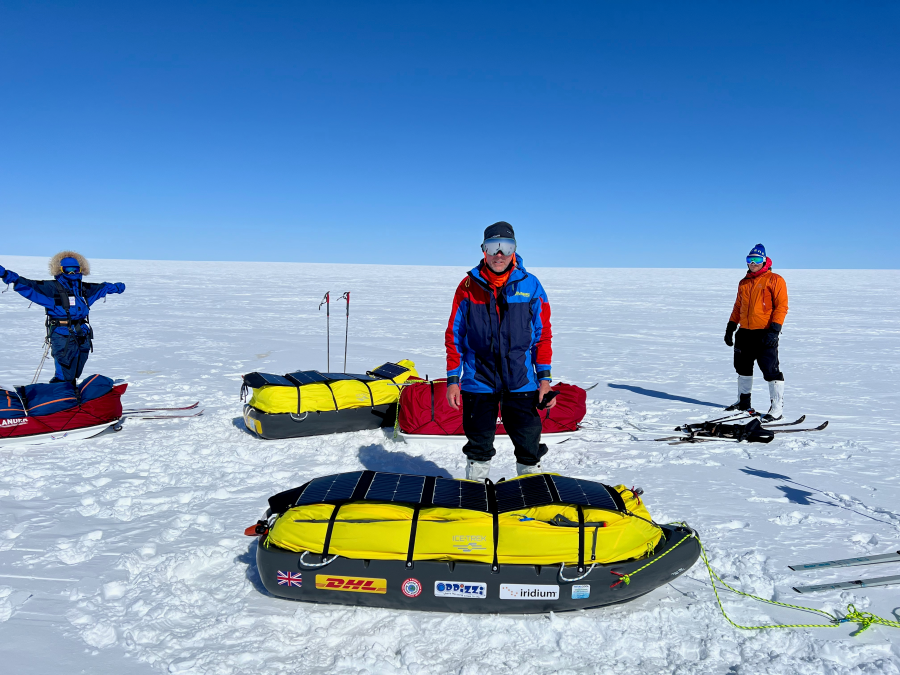
When five adventurers set out pulling 100kg sleds 565km across Greenland’s beautiful, hazardous ice caps, they knew it wasn’t going to be a simple feat. The group, Three Journey’s Round, embarked with a goal to inspire, educate, and promote the idea of living on a better planet through sustainable development.
Adventurer, long-range helicopter pilot, author, and Guinness World Record Holder Peter Wilson helped veteran explorer Mikael Strandberg organize the team’s adventure from Kangerlussuaq to an extraction point called the Grill Hut on the east coast near Isortoq, relying on Iridium Connected™ trackers to map their journey.
“Pulling the sled was the easy part for me; however, living in the -20°C environment was an education,” Wilson remarked on Greenland’s intense weather. “We experienced all conditions from the initial crevasse field, over the top at 2,500m above sea level and down the other side including blue ice, snow, blizzards, howling 80km per hour winds, icy conditions, melting snow, flowing water, and temperatures from 0°C to -24°C with wind chill down to -37°C.”
Sadly, on Expedition Day 2, team leader Strandberg showed severe concussion symptoms after falling in the crevasse field. The remaining members were able to contact medical help using Wilson’s Iridium Extreme® satellite phone. Communicating over the Iridium® network, the mission doctor made his recommendation and a helicopter was sent to the group’s coordinates provided by their Garmin InReach® Mini.
After Strandberg’s emergency evacuation, the remaining members continued and the Greenland icecap further tested their preparation, equipment, and resolve.
Peter Wilson attributes the expedition’s this expedition’s safety to Iridium and Iridium Connected devices. The team used Garmin InReach beacons–connected by Bluetooth® to their phones–for tracking and messaging and Iridium Extremes for communications. These devices helped the team track their progress and provided a lifeline during emergencies.
Team member James Ketchell also used Iridium and Irridium Connected devices as a means to inspire the next generation of adventurers and promote STEM education by hosting virtual field trip calls known as Exploring the World for Kids for K-12 students.
Despite the medical emergency, the team arrived at the Grill Hut safely in just over 29 days.
“I wouldn’t do anything like this without an Iridium satellite phone”
– Peter Wilson, Adventurer, Pilot, Author, Three Journeys Round
“It was so easy for us all to make any necessary calls to family, authorities, Search and Rescue, and in James’ case, his schools obligations answering kids’ questions and the voice pop nightly update to his tracker—[a] very clever service from zerosixzero. The 28 watt-hour batteries seemed to last forever,” Wilson said. “I wouldn’t do anything like this without an Iridium satellite phone.”
Below are some of the many ways Iridium enables reliable connectivity even in the harshest maritime environments, offering numerous benefits for the world’s oceans and those who explore and care for it.
Enhancing Safety and Security
The Iridium network provides a lifeline for mariners, enhancing safety and security at sea. Whether it’s enabling distress signal transmissions, facilitating search and rescue operations, or supporting emergency communication services, Iridium connectivity is instrumental in safeguarding the lives of sailors, fishermen, recreational boaters, and other maritime personnel. For example, the Iridium® Global Maritime Distress & Safety System (GMDSS) enhances safety at sea for mariners, offering a truly global SOS button for emergency situations. Iridium also supports organizations and individuals, including The Outlaw Ocean Project, a non-profit journalism organization that produces investigative stories about human rights, labor, and environmental concerns on the two thirds of the planet covered by water.
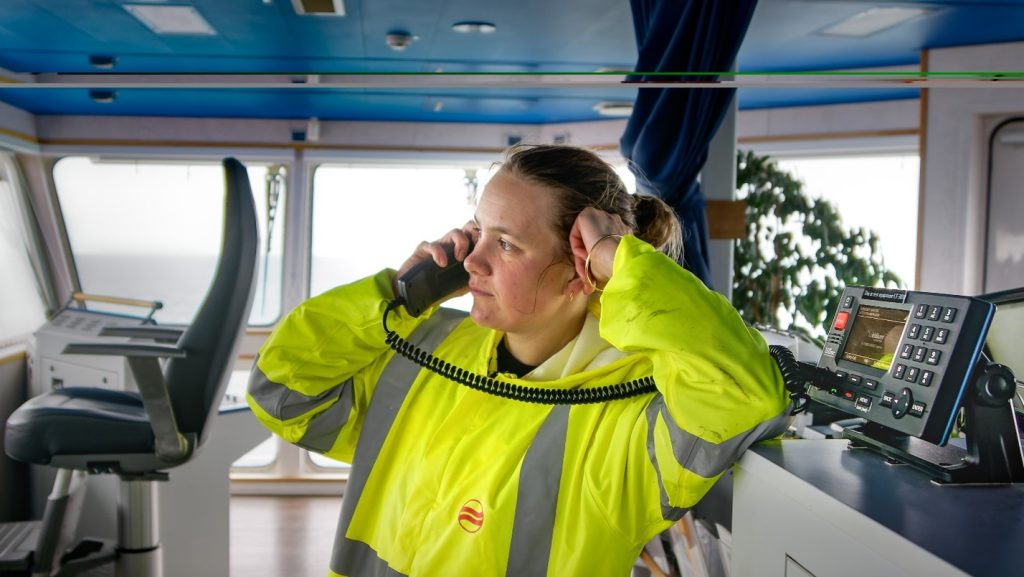
The Lars Thrane LT-3100S, equipped with Iridium GMDSS, on board the Malik Arctica during service trials in the Arctic & Antarctic.
Enabling Scientific Research
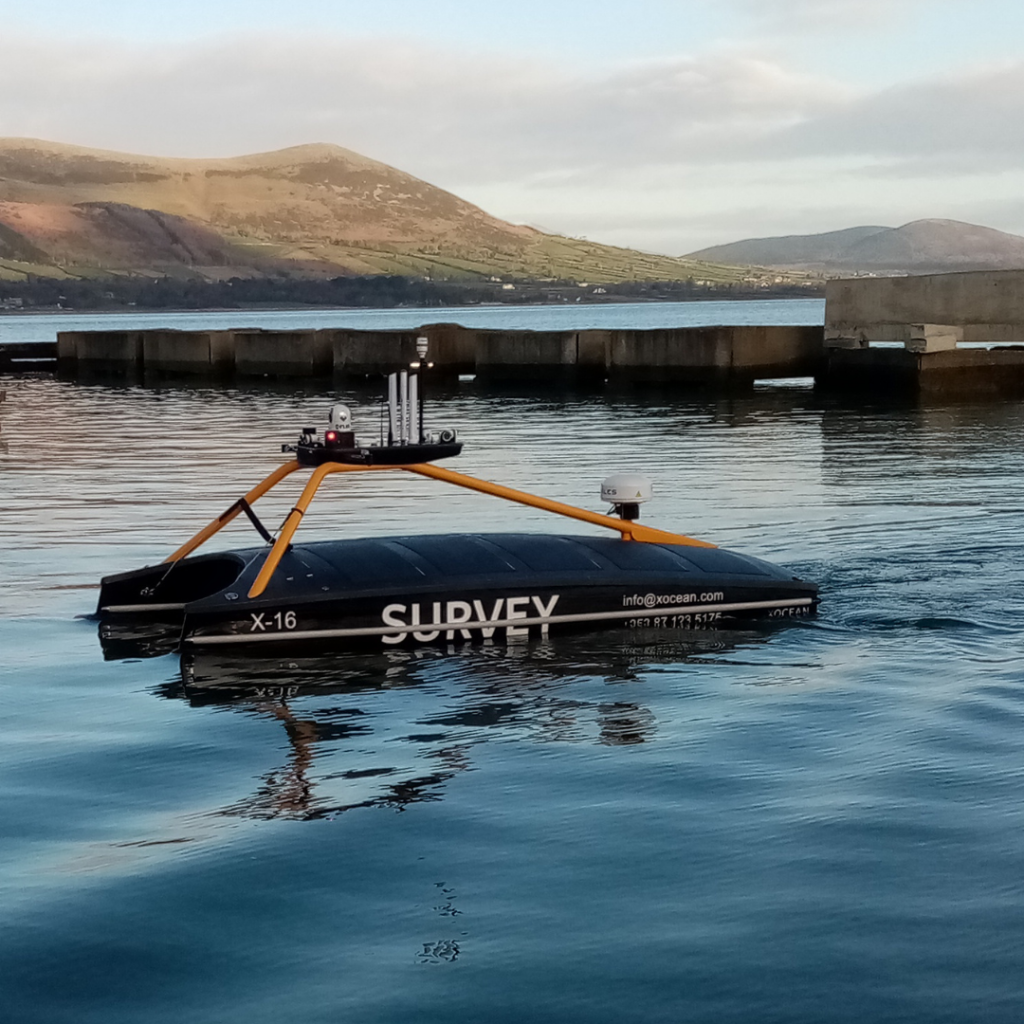
Iridium satellite connectivity supports scientific research by enabling real-time data transmission from remote oceanic locations. Scientists and researchers can collect crucial environmental data, monitor marine life, and study various oceanic processes with greater efficiency and accuracy. Iridium Connected™ devices help Uncrewed Surface Vessels (USVs) and Uncrewed Underwater Vehicles (UUVs) provide a safe, cost-effective, and environmentally sound means of gathering essential data from our planet’s oceans. USVs and UUVs are efficient methods for seabed mapping (bathymetry), subsea asset integrity inspection, fish stock analysis, environmental monitoring, and data collection sent over the Iridium Network.
The XOCEAN USV equipped with an Iridium Connected Thales VesseLINK. Photo Credit: XOCEAN.
Promoting Sustainable Fishing Practices
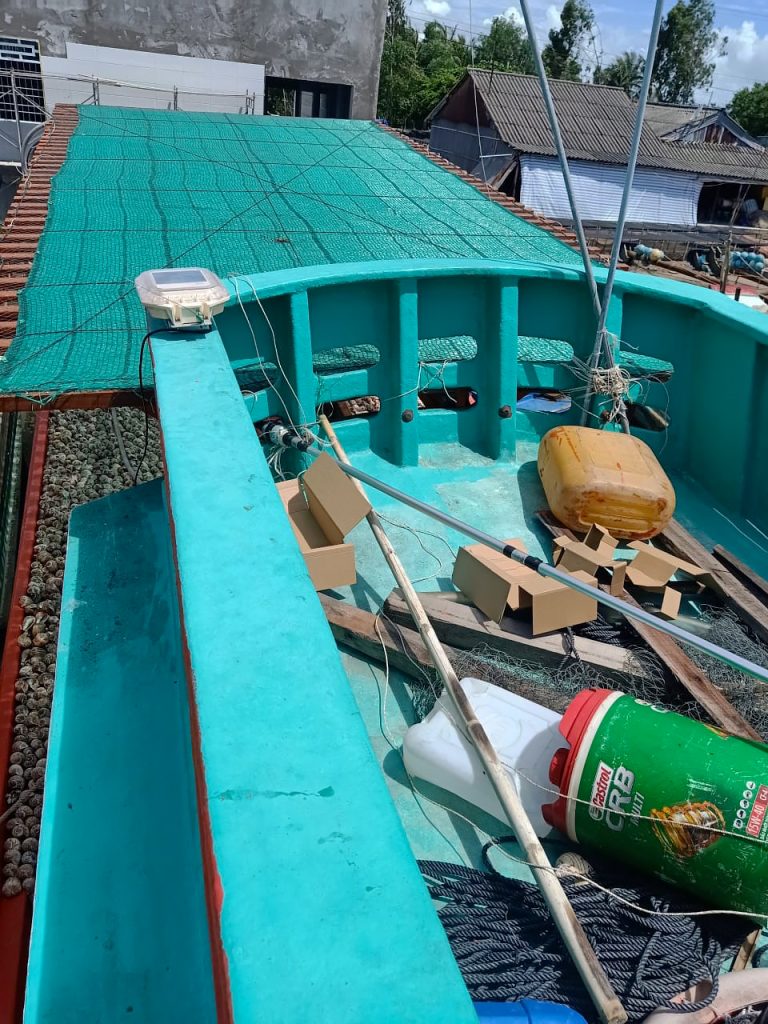
Overfishing and Illegal, Unreported, and Unregulated (IUU) fishing pose significant threats to marine ecosystems. Iridium and Iridium Connected solutions enable the tracking and monitoring of fishing vessels, helping combat IUU fishing and promoting sustainable fishing practices. By providing real-time location data, these solutions empower authorities to enforce regulations effectively and ensure responsible fishing. Iridium provides Vessel Monitoring System (VMS) solutions that provide critical information including fishing quotas and requirements for regulatory authorities to prevent overfishing, catch reporting, and more. An example of this is Iridium partner Viettel’s S-Tracking VMS, which provides up-to-date critical information that supports marine life sustainability in addition to increasing crew member safety. Iridium is also working in close coordination with our partners and regulatory authorities to advance sustainable fishing practices and help ensure marine protected areas remain untouched.
The Iridium Connected Viettel S-Tracking VMS solution on board a Vietnamese fishing vessel. Photo credit: Viettel.
Supporting Marine Conservation Initiatives
Iridium satellite connectivity is invaluable for marine conservation organizations and initiatives worldwide. Conservationists can leverage real-time data transmission to track endangered species, monitor marine protected areas, and develop comprehensive strategies for protecting fragile ecosystems. For example, The Ocean Cleanup is using the Iridium network to support its ambitious goal to rid the world’s oceans of plastic garbage and perform the largest ocean cleanup in history. Iridium connectivity also facilitates communication among researchers, environmental organizations, and policymakers, fostering collaboration and knowledge sharing anywhere in the world.
Facilitating Oceanographic and Weather Monitoring
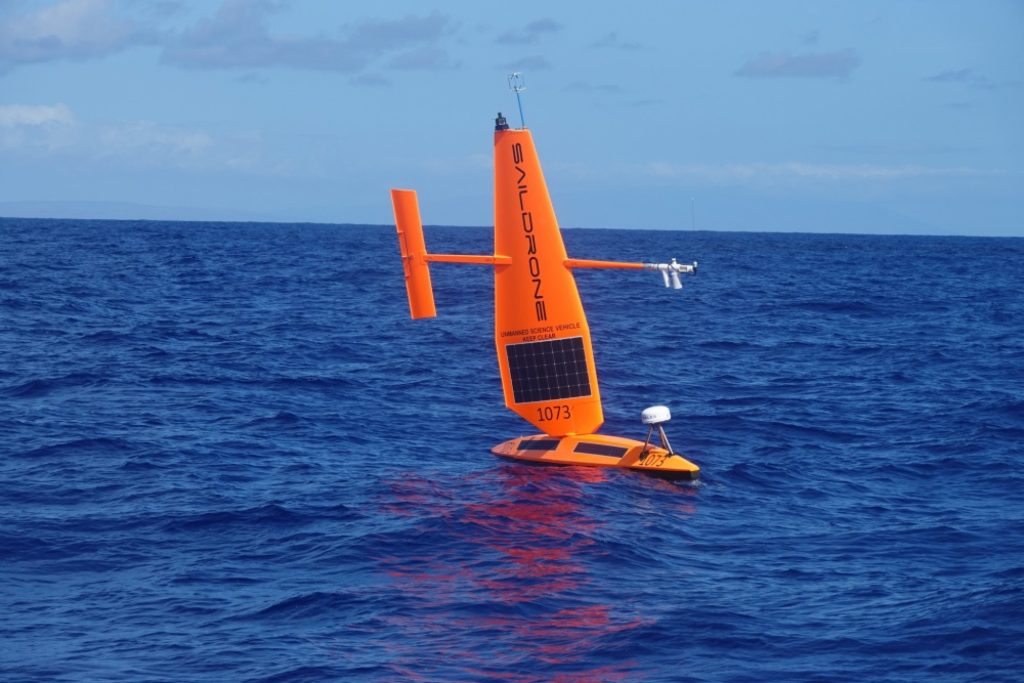
Understanding ocean currents, temperatures, and weather patterns is vital for predicting and mitigating natural disasters, such as hurricanes and tsunamis. Iridium’s satellite network enables oceanographic and weather monitoring systems to gather critical data, contributing to more accurate forecasts and timely warnings. This capability enhances emergency preparedness and helps coastal communities minimize the impact of these natural events. An example of this is Saildrone and its fleet of Iridium Connected USVs, which provided video footage from inside a hurricane. Along with that footage, the Iridium network transmitted wind speed, direction, temperature, and other critical information that will help meteorologists create more predictive models and better understand the impacts of climate change.
The Saildrone USV equipped with an Iridium Connected Thales VesseLINK. Photo credit: Saildrone.
These are just a few examples of how Iridium plays a vital role in supporting the world’s oceans, empowering maritime industries, scientific research, and marine conservation initiatives. With its truly global coverage, reliability, and innovative solutions, Iridium looks forward to expanding efforts to protect and preserve our fragile marine ecosystems. On World Ocean Day and every day, Iridium is committed to ensuring a sustainable future for our oceans and the life they sustain.
Piracy remains a real threat to the maritime community. According to the International Maritime Bureau’s (IMB) most recent piracy report, there were 27 recorded piracy incidents in the first quarter of 2023, with the Gulf of Guinea, Singapore Straits and South America leading the pack in recorded attacks. These modern-day piracy attacks bear no resemblance to the romanticized scenes depicted in Peter Pan and Pirates of the Caribbean of wooden-legged, rum-sipping, swashbuckling buccaneers. Today’s piracy stories are not fantasy, but a harsh and sometimes brutal reality for seafarers. Armed pirates frequently hijack ships and hold crews members to ransom, thefts, and raids, all of which represent a significant risk to ship owners and the lives of mariners. For instance, in 24 of the 27 recorded attacks, perpetrators boarded vessels. The report noted that among these boarding, six crew were kidnapped, two were taken hostage, two were threatened and one was assaulted – proving the threat of violence is very real.
Ensuring a ship has reliable anti-piracy communications is essential to safety at sea for mariners, and satellite communications (SATCOM) plays a critical role.
Here’s Why
When a ship enters a High-Risk Area (HRA), the crew undertakes procedures to both prepare themselves and the vessel for potential pirate attacks. One such method is a secure room that allows the crew to remain safe in the event of boarding. Although no two piracy attacks are the same, a common tactic used by the raiders is to destroy the vessel’s communications antennas, rendering the crew unable to communicate or pass information to coastal authorities. During an attack the crew remain isolated in the safe room, with a single voice line vessel owners and coastal authorities rely on for enacting search and rescue plans.
The Next-Gen Ship Citadel
Vessels operate in many diverse areas around the world, which may fall outside the satellite coverage of many geostationary or even Low Earth Orbit (LEO) networks. The LEO-based Iridium® network provides coverage to all the world’s oceans, meaning a vessel can stay connected wherever it may operate. The Iridium network also operates on L-band frequencies which are more resilient to interference by inclement weather or sea conditions. The antennas used by Iridium terminals are small and lightweight, which allows easy deployment onto any vessel and allows for more discreet placement.
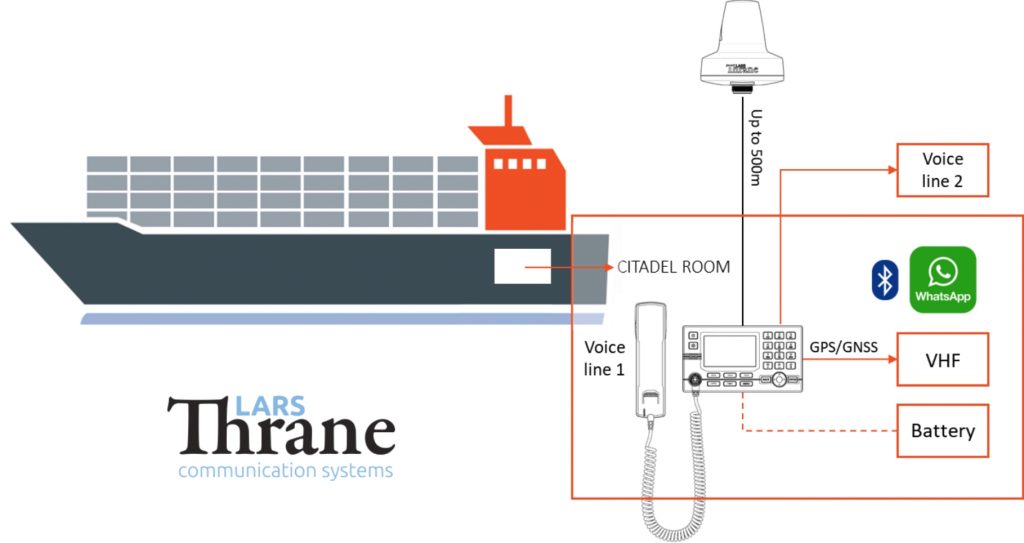
The Lars Thrane satellite communications system is an example of a ship citadel SATCOM solution.
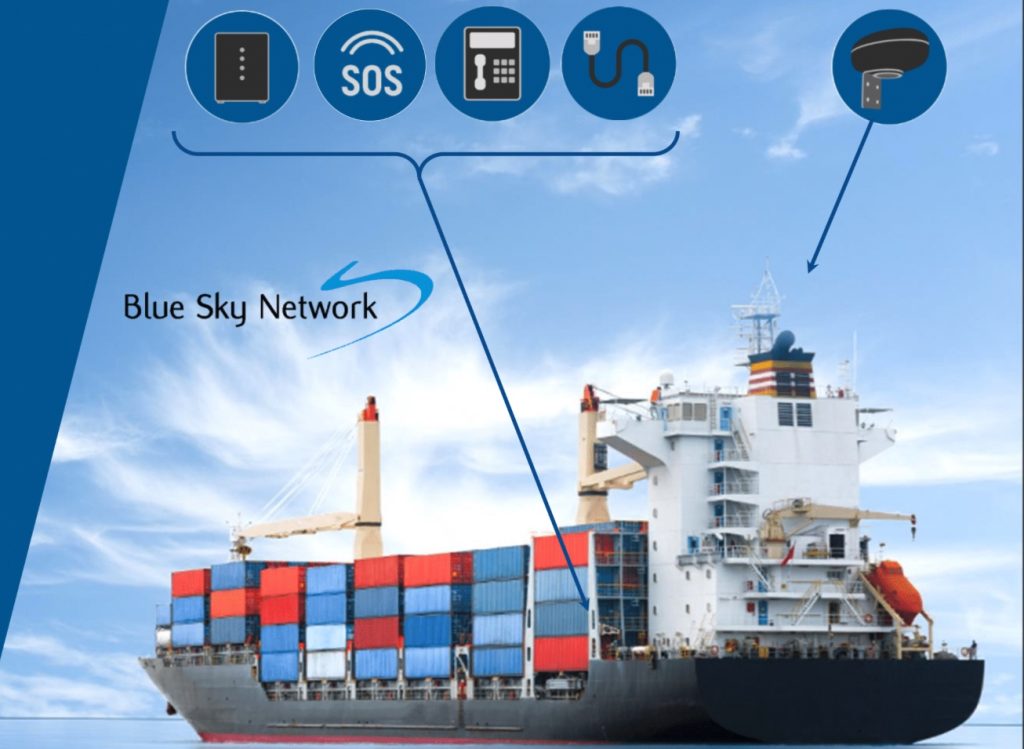
The Blue Sky Network SkyLink Citadel is another example of a ship citadel SATCOM solution.
Iridium Certus® 100 has ushered in a new era of anti-piracy technology with multiple voice lines and IP-based, midband data technology that will dramatically expand the capabilities of a vessel’s citadel communications system. Currently, crew likely have access to limited voice capabilities which can only do so much to help search and rescue efforts.
With Iridium Certus Connected™ terminals like the Blue Sky Network SkyLink Citadel and the Lars Thrane LT-4100 terminal–both with two voice lines, midband data and tracking capabilities–provide crews with a new situational awareness dynamic during piracy attacks. Features such as automatic vessel position tracking, video streaming through onboard security cameras and WhatsApp messaging between crew and authorities can dramatically change the situation and lead to a swifter resolution. Additionally, the antennas for these solutions can be situated over 100m away from the terminals located in the citadel.
As international piracy continues to increase, it is critical that mariners have access to the most secure and capable ship citadel solutions, and they must include SATCOM.
The global Uncrewed Aerial Vehicle (UAV) market is expected to reach $70.91 billion by 2030. This projected growth reflects the huge potential of UAVs beyond hobbyists and government applications. In this edition of exPLANEd, we explain what UAVs are, how and why they are used, review their specific set of communications needs and how Iridium® satellite communications (SATCOM) is helping to make UAV flight possible and successful.
What Are UAVs & Why Are They Used?
Uncrewed Aerial Vehicles (UAVs) are just that: vehicles operating in the air without a crew on board. They are used for missions that require flight to areas too dangerous or not ideal for flying a crewed aircraft. Examples of these areas and use cases include remote inspections (think remote pipelines, rail and power line monitoring), disaster recovery and surveillance efforts, environmental monitoring in uncharted territories and more.
Piloting remote aircraft, especially Beyond Visual Line of Sight (BVLOS), meaning the pilot is responsible for operating the aircraft even when it is no longer in their view, comes with a specific set of communications requirements. UAV pilots must be able to make critical, split-second Command-and-Control (C2) decisions mid-flight–such as rerouting a mission due to unexpected weather patterns and air traffic. They also need access to a constant flow of critical data, including but not limited to navigational, weather and aircraft health information. Most importantly, these pilots need to know that no matter where they are required to fly their aircraft, they will have access to fast, reliable connectivity, and Iridium Connected™ technologies are uniquely qualified to support these needs.
How Iridium Benefits The UAV Market
Global Line of Sight®
Iridium operates the only truly global satellite network. Its crosslinked constellation of Low Earth Orbit (LEO) satellites creates a web of coverage around the entire planet, including locations that lack connectivity, like the Arctic. This is ideal for UAVs because no matter where they fly, a pilot can control and observe the aircraft regardless of how far away the vehicle is. With Iridium, BVLOS C2 is a specialty. Also, because of the network’s location in LEO, it delivers low-latency connectivity that makes near real-time data delivery possible, which is essential for these aircraft.
Highly Reliable Satellite Connectivity
In addition to enabling truly global coverage, Iridium’s connectivity is delivered over weather resilient L-band satellite spectrum, making it ideal for delivering critical communications solutions, such as connectivity for UAVs. For remote pilots, safety is the top priority, and there is no larger threat to flight safety than unpredictable weather patterns. For example, if a sudden storm passes through and a pilot needs to change flight plans–taking the aircraft BVLOS to avoid dangerous conditions–Iridium technology is a must-have.
Highly Accessible and Flexible
Iridium has a vast partner network of over 450 companies around the world, making Iridium technology very accessible. While Iridium technology is perfect as a primary communications system on board a UAV, it can also act as a backup to traditional line-of-sight or cellular technologies, kicking in for BVLOS and C2 needs.
Today, Iridium is connecting UAVs around the world and across multiple industries. For instance, UAV company Swoop Aero integrated Iridium technology into its drones’ C2 systems to deliver critical medical supplies on the island nation of Vanuatu, where access to life-saving treatments is limited due to its lack of infrastructure and remote location. In collaboration with UNICEF and Vanuatu’s Ministry of Health, Swoop Aero created an on-demand vaccine delivery program that quickly brings vaccines to local nurses and healthcare workers in temperature-controlled packaging, ensuring the safe delivery and administration of vaccines to the population. This is just one of many examples of how Iridium is enabling innovative applications for the fast-growing UAV market.
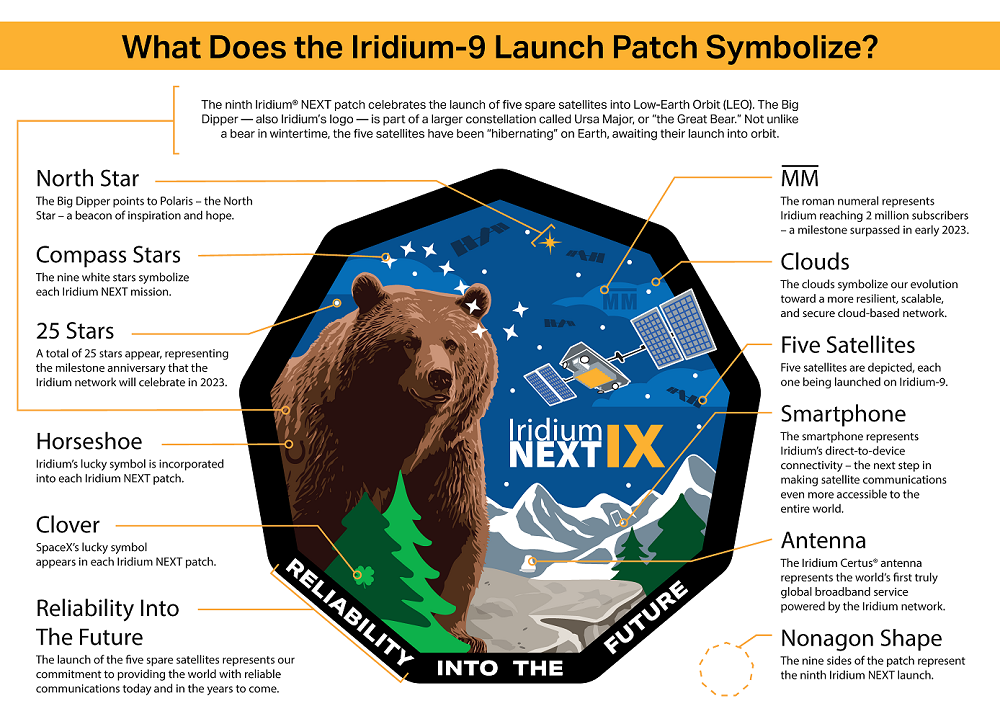
Bear with us as we share the meaning behind the Iridium-9 patch.
A symbol of courage, patience, strength, nobility, and playfulness, the bear represents a lot of similar qualities to Iridium.
Every detail of this patch represents how far Iridium has come since the successful completion of the Iridium® NEXT launch campaign. Just like a bear after a long winter, the five Iridium-9 spare satellites are coming out of hibernation–helping to ensure the Iridium network’s reliability into the future.
Learn more about each aspect and hidden meaning of our Iridium-9 launch patch below.
Hi again. It’s been a while, and wow has a lot happened since the Iridium-8 launch (Ok fine, Iridium-8 wasn’t exactly the last, last flight of this generation of satellites. In our defense, these are spares).
We kind of knew we’d get at least one more shot at a playlist, but YOU all voted to have “The Final Countdown” on the last playlist. We will accept half the blame. Deal? Ok, we’ll accept 75%. Final offer.
For those of you who have no idea what we’re talking about, see the following:
Our playlist is designed to do a number of things:
It’s Choreographed
Each song–its lyrics and timing–are very important to the experience.
Those of you who played along previously know, for example, that liftoff occurs at a very specific moment of “Thunderstruck” by AC/DC. That song is forever the liftoff song. #SorryNotSorry. After that, the songs change but the experience remains the same (i.e. when the satellites are separating from the dispenser, you’ll get songs about “separating,” “dancing away,” or analogies thereof.)
There’s Something For Everyone
A key goal is to ensure we have a diverse array of music, so a variety of artists and genres are included in hopes of having something for everyone. We think we’ve struck that balance again and hope you agree!
Live Tweets
On launch day, make sure to pay attention to our Twitter account, where we’ll be tweeting out updates, timing to press play if you’re joining late and a quick bit about why each song was chosen.
How It Works
The Iridium-9 Launch Playlist can be found on Spotify. Here’s a step-by-step guide to help you join the fun.
Search for the Iridium Communications Inc. account on Spotify, and make sure it’s the one that’s verified! Or use this link to directly access the playlist.
Select the Iridium-9 Launch Soundtrack from the playlists section. You should now see all the songs in order.
Once the SpaceX webcast begins, find the timer in the top right corner of the screen that shows a countdown to launch.
When the countdown timer reaches 6 minutes and 8 seconds, press play (THIS IS IMPORTANT!!!) on the first song of the playlist, and then just let it play. (We recommend keeping the volume low enough to hear the host clearly!)
5A. If you joined the show late, or had to pause the playlist, have no fear. We will be live tweeting at what point on the timer (that same one in the top right corner), each new song will start, giving you an opportunity to get back in the game! For example, you may see a tweet like this:
“To catch up with the playlist, press play on Iridium-9 Launch Soundtrack Song – [SONG NAME] at T+12 minutes 32 seconds #Iridium9”
After that, there’s nothing left to do but watch, listen and enjoy. And yes, everything that happens–the timing, the words, the irony–has been painstakingly designed to create a unique viewing and listening experience.
WARNING: This will only work seamlessly for Spotify Premium users. (aka, no commercials)
But, we’ve got you covered. The playlist is included at the bottom of this post so everyone without Spotify Premium can build the list themselves. We just ask that you pay close attention to song lengths and versions, to make sure things line up as accurately as possible!
How We Picked The Songs
As Rob Gordon points out in High Fidelity: “The making of a great compilation tape…is hard to do and takes ages longer than it might seem.” The songs have to make sense, the length of the songs has to work out so the viewing experience is coordinated with the video feed and more.
The Criteria
• Avoid profanity, explicit lyrics or graphic language
• Avoid the same songs and the same band/artist (not inclusive of “feats.”)
• Allow one exception to the Avoid The Same Songs Rule (c’mon, you can probably guess what this one is for!)
• Avoid clichés (no “Rocketman,” sorry)
• Allow one exception to the Avoid Clichés” Rule
• Relate to either what is being viewed on screen, the Iridium story or our business
• Matt picked it (per tradition, our CEO, aka @Iridiumboss, selects one song)
• Represent a broad/diverse array of music/artists/bands
• Serve as an ode to a relevant person, place or event
• Represent some level of irony if the song doesn’t fit in another category
We hope you join us on this musical journey!
Official Iridium-9 Launch Playlist
SONG
ARTIST
ALBUM
LENGTH
Finale (feat. Nicholas Petricca)
Madeon
Finale
3:25
Thunderstruck
AC/DC
The Razors Edge
4:52
Interlude: Moving On
Paramore
Paramore
1:30
In the Stars
Icona Pop
THIS IS… ICONA POP
3:17
All I Do Is Win (feat. T-Pain, Ludacris, Snoop Dogg & Rick Ross)
DJ Khaled
All I Do Is Win
3:50
Good Morning
Chamillionaire
Good Morning
3:32
I Think We’re Alone Now
Tiffany
Tiffany
3:48
Look What We’ve Become
Grace Potter
Midnight
3:11
Thunder
Imagine Dragons
Evolve
3:07
Dynamite
BTS
BE
3:19
Oh, What a World 2.0
Kacey Musgraves
Oh, What a World 2.0 (Earth Day Edition)
3:39
Family Affair
Mary J. Blige
No More Drama
4:25
Count on Me
Bruno Mars
Doo-Wops & Hooligans
3:17
My Shot (feat. Busta Rhymes, Joelle Ortiz & Nate Ruess)
The Roots, Busta Rhymes, Joell Ortiz, Nate Ruess
The Hamilton Mixtape
4:30
Unstoppable
Sia
This Is Acting (Deluxe Version)
3:37
HELP! - Remastered 2009
The Beatles
Help! (Remastered)
2:19
Takin’ Care of Business
Bachman-Turner Overdrive
Bachman-Turner Overdrive II
4:49
Our House
Madness
Madness
3:21
Let It Go
New Found Glory
From The Screen To Your Stereo 3
3:16
Birthday Party
AJR
Neotheater
3:43
Come Out and Play
The Offspring
Smash
3:17
Breaking Free
Nini, Rickey & E.J. Version
High School Musical: The Musical: The Series (Original Soundtrack)
A new short film series produced by The Outlaw Ocean Project
There can be a lot of “commocean” on the high seas. Award-winning investigative journalist and Executive Director of The Outlaw Ocean Project Ian Urbina knows this firsthand. Expanding upon the stories shared in The Outlaw Ocean Podcast comes a new 10-part short film series called Dispatches From The Outlaw Ocean: The Last Untamed Frontier. The series features a decade’s worth of exclusive footage and reporting from Ian, exploring the most lawless aspects of the high seas that are often met with impunity and overlooked.
Each episode gives viewers an inside look at offshore crimes such as environmental destruction, slavery and more. Ian Urbina chronicles it all (the good and the bad) through in-depth investigative reporting, including interviews with present day pirates, mercenaries, smugglers, traffickers, shackled slaves and vigilante conservationists.
Curious? We are too and we have good news: the first episode is available now, with new episodes airing weekly. Click here to watch Episode 1, Where Killers Go Free.
We are proud to support The Outlaw Ocean Project as we continue to provide Ian and his team with Iridium® connectivity for their adventures and important work. In case you missed it, check out our Q&A with Ian Urbina to learn more about his story.