Hurricane season is upon us again, coupled with a rapidly-increasing scale and frequency of other extreme weather events. These disasters are raising questions on preparation and response best practices for individuals and communities, especially when land-based communications networks are impacted.
Hurricanes in recent years have devastated coastal regions of the United States and shut down land-based communications networks for days, and sometimes weeks, after cell towers were destroyed. In 2022, Hurricane Ian knocked out nearly 50% of cell sites in Florida’s most affected counties. This year, extreme heat and wildfires have been an additional cause for concern. The catastrophic wildfires in Maui rapidly downed cell service, preventing some people from reaching emergency services or communicating with loved ones.
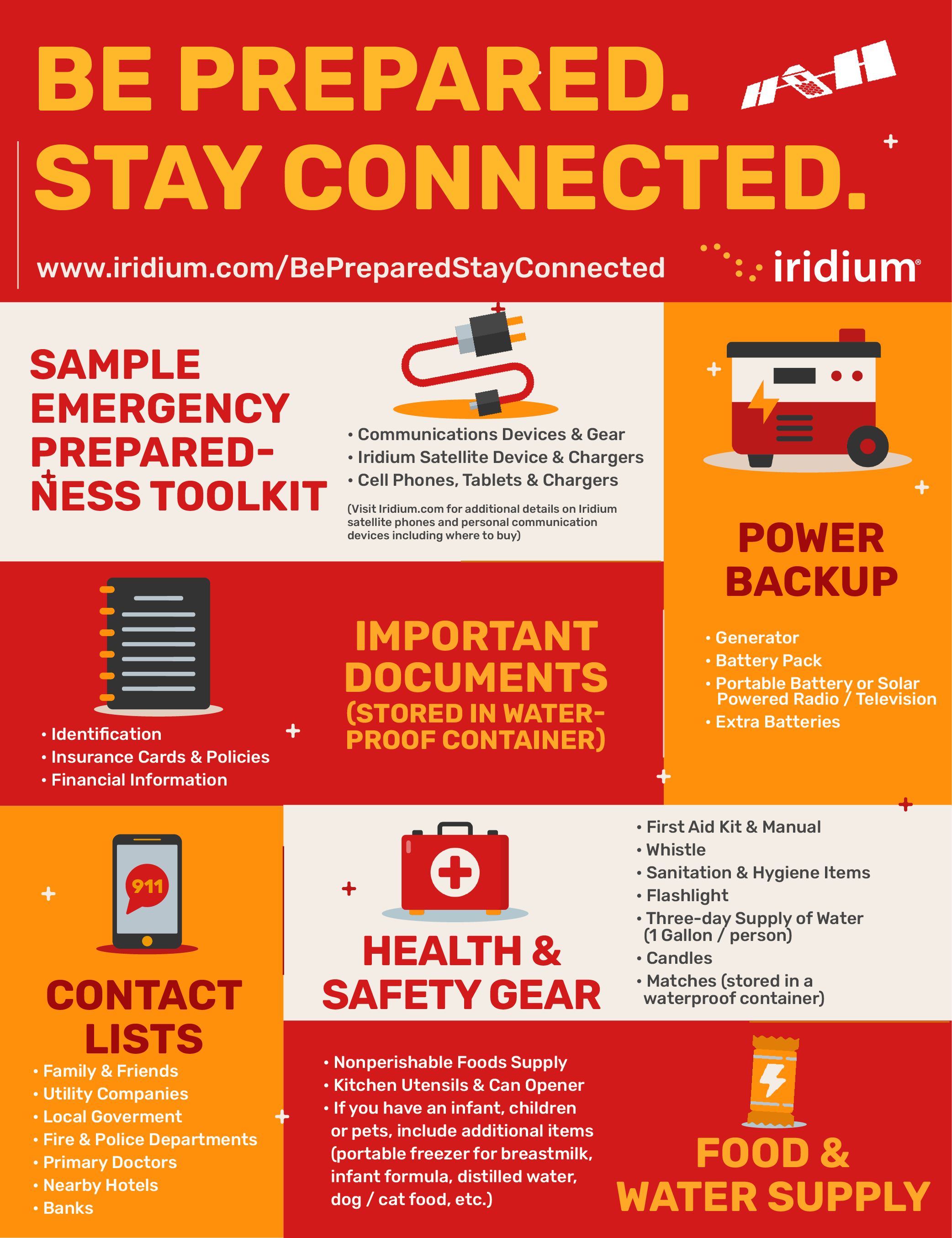
Josh Miner, Iridium’s Vice President of Land Mobile, recently sat down with Virginia News Network (VNN) and Florida News Network (FNN) to discuss how widespread outages caused by devastating events like these have underscored the need for dependable satellite communication technology, ensuring reliable connectivity in times of need. For individuals and businesses alike, being prepared for natural disasters is key. When internet and cell networks go down, satellite communication (SATCOM) infrastructure can save lives.
The Issue With Cellular Network Reliance
Cellular and land-based networks are constantly evolving to provide stronger connectivity, but as we’ve seen, these networks are not impervious to outages during natural disasters and extreme weather events. Cell towers are dependent on local telecommunication infrastructure, meaning connectivity can be vulnerable to damaging events like flooding, fire, and high winds carrying debris.
Vulnerabilities to local network foundations can lead to unreliable cellular connectivity, stalling relief and location efforts, preventing continuation of critical business operations, and keeping victims of disaster events from communicating with friends and family. Josh explains how preparation for these types of outages is paramount. We keep backup plans handy for many situations – spare tires for flats, extra batteries for flashlights – why not a backup for communications?
Enter: SATCOM
Satellite communications offer a non-localized solution to problems linked to cellular networks during natural disasters. Iridium offers exceptionally reliable voice and data communications that provide connectivity in adverse weather conditions, independent of local communication infrastructure, by routing calls to gateways out of the disaster area so users can stay connected.
Iridium is the only fully global satellite network that ensures connectivity across the entire planet, even the most remote, off-the-grid locations. Located in Low Earth Orbit (LEO) with an L-band frequency, Iridium can provide a weather-resistant connection that stands up to unfavorable conditions. This is particularly useful when coordinating rescue efforts and keeping businesses operating in times of disaster.
Josh explains that, alongside our strong partner ecosystem, Iridium is able to leverage its unique network capabilities to offer a wide array of connectivity options for any need and situation:
Hotspot network devices like the Iridium GO! exec® provide reliable connectivity in any environment, allowing users to consistently communicate with family and loved ones.
Higher bandwidth antennas and terminals can provide mobile broadband to entire buildings and vehicles, helping businesses and local authorities stay operational, even in the worst conditions.
Iridium is Here to Help
No matter the disaster or situation – from prep and planning, to rescue and relief, to repair and restoration – Iridium has your back in times of extreme weather and natural disaster. So, add SATCOM to your emergency preparedness checklist today and gear yourself with dependable connectivity and safety in the face of the next widespread outages.
Every September, we celebrate Deaf Awareness Month—bringing awareness and visibility to the communication needs and unique identity of deaf and hard of hearing people—and National Service Dog Month—honoring the life-changing impact service dogs make on people with disabilities every day.
In case you missed it, Iridium’s IT Project Manager & Scrum Master, Natasha Hitzeman, shared their story as part of our Behind The Network series. Now, Natasha has a new co-worker and best friend we find particularly paw-some : service dog Pavlov!
Learn more about Natasha and Pavlov in this Q&A.
Can you please introduce and give a little background on yourselves?
Natasha: As you may have guessed so far, my name is Natasha, I’ve been with Iridium for about four and a half years and have a dual role as a Scrum Master and IT Project Manager. I love my role at Iridium and the chance to help bring some of our projects from idea to reality! I am also profoundly deaf in both ears. I can only hear things that are really loud and really low pitch, like a tuba if it’s right up in my ear. I often switch back and forth between English and American Sign Language (ASL), but there are still so many things around me that I’m oblivious to, and that’s where Pavlov comes in!
Pavlov: Woof woof!
Natasha: Okay, maybe I should translate. Pavlov is almost six years old and is a boxer mix. He provides much needed awareness to sounds around me—like alarms, doorbells, and general situational awareness (people walking up behind me, doors opening, etc.). Pavlov also absolutely embodies his namesake. In our case, no matter where he is in the house, if he hears our backdoor sensor chirp, he comes running!
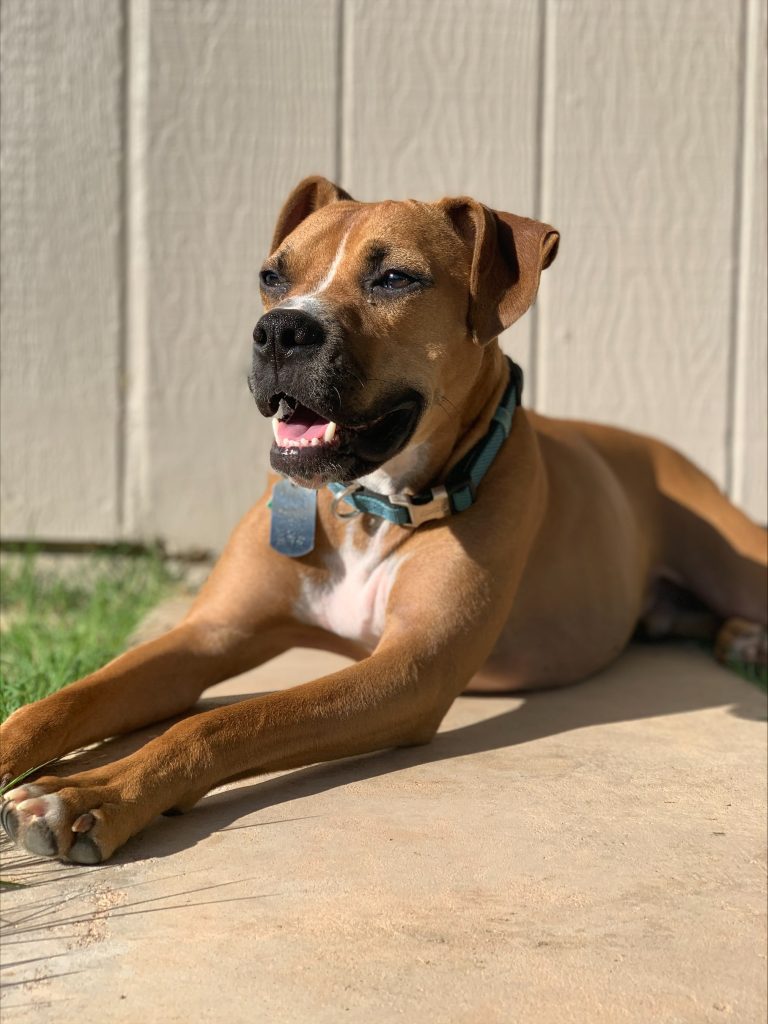
Pavlov chillaxes in the Arizona sunshine.
How long has Pavlov been your service dog? Can you tell us the story of how you met?
Natasha: Officially, he has been my service dog for about a year. We adopted him almost six years ago as a puppy (If you saw his puppy pictures, you would impulse-adopt too!), and we started obedience training from day one because we just wanted him to be well-behaved as a pet. We didn’t adopt him with the intention of him becoming a service dog, but over time it became clear that he would be a good fit for me. I had been on two different waiting lists to get a service dog for over five years with no movement. I’ve wanted a service dog since I was a teenager, so I finally decided to look more into self-training.
Pavlov: One day these nice people came to play with me for a bit, then suddenly they took me home, and I’ve been here ever since! A while later, we started practicing new things, and one day they told me I was taking a test! I guess I passed because I have my own uniform and everything.
How long did Pavlov’s evaluation and training take? How has the transition been for you both?
Natasha: The evaluation took about three months, including reaching out to various training organizations and the different observation settings. It took about eight months to pass his public access test, and we continue to practice skills weekly. If he were a puppy or had little obedience, it would have taken about one and a half to two years. He already had a strong foundation, so we had a head start.
The transition for me has been amazing! I used to have a lot of anxiety about not being aware of things around me, and Pavlov really alleviates that. Training is something that never stops, and it’s great to see how Pavlov handles all kinds of new situations and experiences. Plus, Iridium was really great about me incorporating him into my hybrid work schedule.
Pavlov: I used to nap whenever I wanted, but now I have to go to someplace called “work” and grocery shopping and stuff. It’s okay, though. I get lots of treats for good work, and people compliment me on my summer shoes that protect my paws from the Arizona heat.
Can you share what a day in the life of a service dog is?
Pavlov: On days when I work from home, I play and nap as much as I want until I hear one of those sounds that I’m supposed to tell Natasha about (Don’t ask me what the sounds mean. I just tell Natasha, and they figure it out.). When we go to work, I get dressed in my work vest, my leash, and my summer shoes so my feet don’t burn. Work doesn’t have as many doorbells to tell Natasha about, but there are always people walking around and doors opening so I have to pay attention!
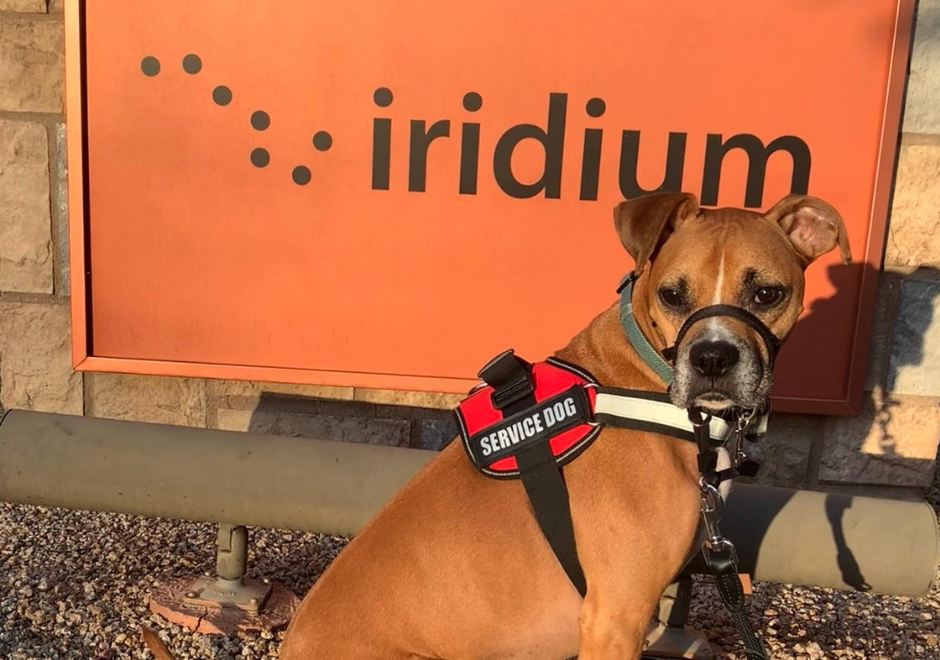
Pavlov clocks in for work at Iridium’s Tempe, Arizona, office
Are other people allowed to pet Pavlov?
Natasha: Always ask first. Depending on what’s going on, I’ll usually say yes but I need to give Pavlov a release command first. Since he was a pet first, we had to create a clear distinction between being on duty and off duty so he knows when he can act like a pet versus a service dog. Part of this means making sure he doesn’t solicit attention from people unless given permission first.
Pavlov: Gimme all the pets! Shhh…..I won’t tell Natasha.
Is there anything else our audience might not know about service dogs for the deaf that you’d like to share?
Natasha: A lot of people who see Pavlov are usually curious about the Gentle Leader he wears around his nose. This is used often by those who are deaf because it allows for more situational awareness without putting the pressure on their service dogs. For example, if Pavlov turns his head to look at a sound, I can feel that movement and look in the same direction, but he doesn’t have to alert me to every single thing he hears.
Pavlov: It’s hard work! Sometimes I have to remember my training and how to tell Natasha that there is a sound. Sometimes there’s a sound I’ve never heard before, and I have to figure out what to do with it! Other than that, being Natasha’s service dog is paws-itively awesome!
Five Iridium® employees are gearing up for the Rebelle Rally this October. The first women’s off-road navigation rally in the United States and the longest competitive off-road rally in the nation, the Rebelle Rally blends the love of driving with the ultimate challenge of precise map and compass navigation over 8 days of competition.
Covering more than 2,000 kilometers (approximately 1,200 miles) across the Nevada and California desert, competitors can use only maps, compasses, and a roadbook to find both marked and hidden checkpoints. With no cell service and limited access to everyday technology, Iridium stands as the official communications and safety partner for the Rebelle Rally.
Teams consist of two members: a driver and a navigator. This year, Iridium will have two teams participating:
Team Desert Crush (#163): Director of Program Management, Isa Budge, and Data Scientist, Lauren Severson
Team NEXT Wave (#133): Senior Engineer, Cindy Swazey, and Principal Engineer, Annabelle DaSilva
Senior Engineer, Kimberly Carte, is also training alongside the group as a substitute teammate.
In preparation for the rally, the women are dedicating many hours and weekends of training both on the road and in the classroom at Rebelle U. The teams are learning a series of metric conversions, how to plot points on a map, general navigation, and more. They’re also practicing off-road driving and car maintenance, such as what wheels to purchase and how to lift one’s vehicle in an emergency.
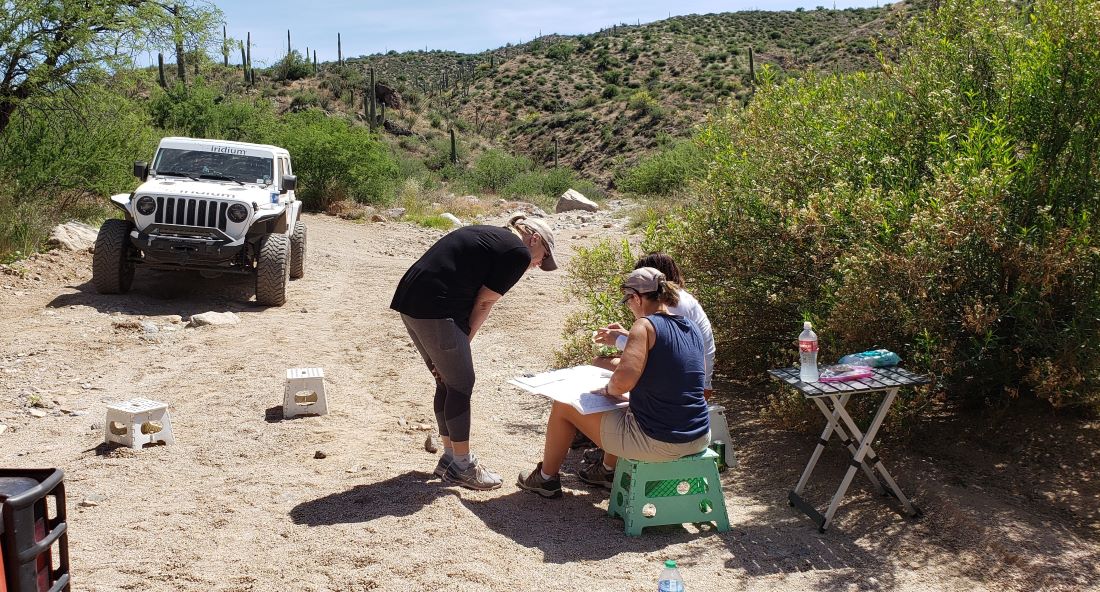
An Iridium Rebelle Rally team in training.
“The training teaches you to thrive not just survive. You learn what you need to be prepared for to enjoy it,” said Isa. “This includes tips on what to pack in your car so that you have the bare necessities without any of your materials getting lost or damaged when you’re driving over rocky terrain.”
For competitions like these, preparation is a key determiner of success. Iridium’s COO Suzi McBride, who previously participated in three Rebelle Rally’s is excited to pass the baton to these future Rebelles and is offering advice on what to expect during the competition:
“I am so proud of Iridium for sponsoring this event and for sending two teams to the 2023 Rebelle Rally,” said Suzi. “It’s a great showcase for how Iridium is used in the remote outdoors, for safety and for one of the most challenging competitions.” She continued, “I have told the new Iridium teams – you will learn you can dig deeper and do more than you ever imagined in this process. You will not master the Rally in one year so don’t expect to win or even be top 10. Work to get a little better each day, be kind to your partner as there will be very tough days ahead and be present in the moment and take it all in and enjoy!”
One of the most impactful courses during training was the Rebelle Enduro Challenge (REC). With limited time to plot and calculate, the teams are given specific pathways where they must drive at exact speeds and times to reach their correct destination. “The car does not stop moving,” said Lauren. “The REC’s last 20 minutes and there’s no guarantee that your calculations from the morning will get you to the correct point with the prescribed speed.”
The accuracy of their coordinates, which are used for scoring, is determined by Iridium Connected® YB3 trackers. At each marked or calculated checkpoint throughout the Rebelle, competitors signal their location using the device and the appropriate points are awarded. YB3 trackers are also attached to each vehicle for safety tracking and for friends, family, and coworkers to follow their location live online. Along with partners Icom, Roadpost, and YB Tracking, Iridium keeps Rebelles and the support staff safe and connected while they race along the southwest desert.
Training has been a challenging but rewarding experience for the women, since a lot of the skills they are learning are not instinctual. The Rebelle’s are used to relying on their cellphones for communications and navigation, so learning to travel without them has felt empowering. They hope that their experience inspires others to learn more about the competition and become involved.
“I don’t know if I would have the opportunity to try off-roading had I not signed up for this. I also wouldn’t have met or gotten to know these amazing ladies from other parts of Iridium or the other talented women competing,” said Isa. “The expert off-roaders who work with Rebelle Rally have always spoken to what an amazing privilege it has been to have Iridium support them. We are very proud to represent Iridium at the Rebelle Rally.”
Iridium’s Rebelle Rally Participants, left to right: Lauren Severson, Isa Budge, Annabelle DaSilva, Cindy Swazey, Kimberly Carte
Iridium is proud to be the exclusive safety and communications partner for the Rebelle Rally and to have Isa, Lauren, Cindy, Annabelle, and Kimberly participating this October.
MCLEAN, VA., September 19, 2023 – Iridium Communications Inc. (Nasdaq: IRDM) is proud to announce its partner, McQ Inc., in collaboration with designer and manufacturer Barnacle Systems, has introduced a remote monitoring solution for fixed assets in the Arctic supporting the Department of National Defense and Canadian Armed Forces (DND/CAF). BRNKL Arctic Deploy is an innovative solution for the DND/CAF to monitor and secure ground-based assets operating remotely in the Arctic over Iridium’s weather-resilient, truly global satellite network.
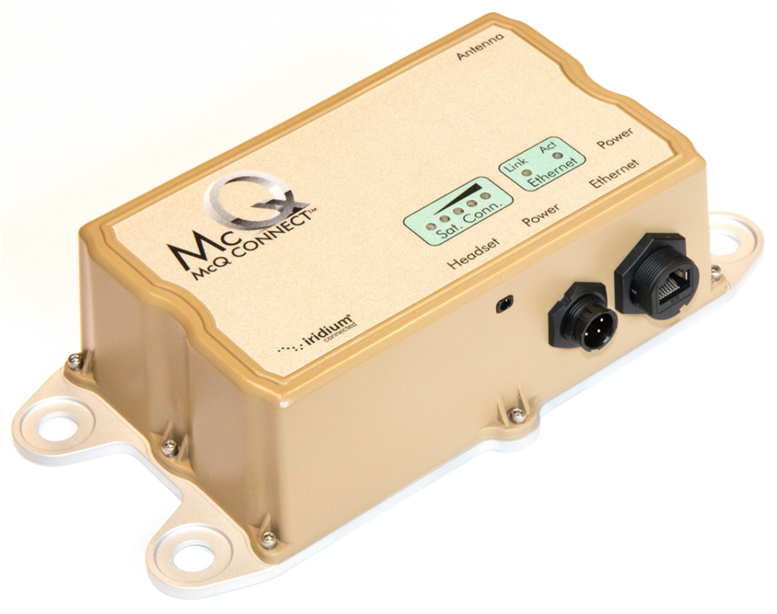
An autonomous remote monitoring solution, BRNKL Arctic Deploy utilizes McQ CONNECT® advanced sensors to transmit data, including alerts and short video clips, over Iridium Certus®. The portable remote monitoring system uses McQ’s rScene® micro radar capable of vehicle and person classification, in tandem with computer-vision assisted live video streaming for motion and intruder detection.
McQ CONNECT
BRNKL Arctic Deploy includes enhanced situational awareness and improves the overall safety, security, and efficiency of remote operations. It can be deployed in disaster-affected areas, providing critical information to emergency response teams. It can also be adapted for monitoring wildlife populations, migration patterns, or environmental changes in remote locations.
“We are proud of the continued innovation by our partner McQ as they create the highest quality Iridium Certus Connected® products that provide secure and reliable video, sensor and data transmission,” says Scott Scheimreif, executive vice president, government programs, Iridium. “The BRNKL Arctic Deploy is a well-suited innovative solution for remote monitoring and communication in the most extreme environments where the DND/CAF serve.”
Iridium® is the only mobile voice and data satellite communications network that spans the entire globe. Iridium enables connections between people, organizations and assets to and from anywhere, in real time. Together with its ecosystem of partner companies, Iridium delivers an innovative and rich portfolio of reliable solutions for markets that require truly global communications. In 2019, the company completed a generational upgrade of its satellite network and launched its new specialty broadband service, Iridium Certus®. Iridium Communications Inc. is headquartered in McLean, Va., U.S.A., and its common stock trades on the Nasdaq Global Select Market under the ticker symbol IRDM. For more information about Iridium products, services and partner solutions, visit www.iridium.com.
Press Contact:
Jordan Hassin
Iridium Communications Inc. Jordan.Hassin@iridium.com
+1 (703) 287-7421
Investor Contact:
Kenneth Levy
Iridium Communications Inc. Ken.Levy@Iridium.com
+1 (703) 287-7570
Every year, the Society of Satellite Professionals International (SSPI) announces their 20 Under 35 list of space & satellite employees or entrepreneurs age 35 and under who have demonstrated outstanding achievement in the early stages of their career and are expected to have a profound impact on our industry in the future. In this Q&A, we sit down with 2023 SSPI 20 Under 35 recipient and Iridium® Space Systems Engineer Neha Lin.
When did you first become interested in space and engineering and decide you wanted to pursue the field as your career?
As a little kid in school, I was always interested in math. Numbers made sense to me, and solving problems was fun. While attending graduate school, I met my husband who was working on small satellites at the time and became an aerospace engineer. Because of my background, we worked on a few projects together, and that was my introduction to the various aspects of the space industry. It was fascinating to learn how heavily the space and electrical industry coincide with one another.
Neha and her husband—Iridium Engineer Jimmy Lin
How did you end up working at Iridium?
In college I had the chance to work with small satellites, and through that experience I indirectly learned about Iridium. However, it wasn’t until many years later during a move to Virginia that I was recommended for a position at Iridium. It was a new career path for me, but it was exciting knowing that I would be able to apply my knowledge to finally work in the space industry.
What is your favorite memory so far working at Iridium?
I started my adventure at Iridium during the second-generation satellite launch campaign, known as Iridium NEXT. During this time, I had the pleasure of interacting with the Thales Alenia Space experts regularly. The best moment for me would have to be the third launch in October 2017, when we made first contact with the newly launched satellites. I was at the Mission Control Center for that launch, and it was so exciting to be surrounded by my colleagues cheering and celebrating the momentous event together. It was a very surreal experience for me, and following all the successful launches, the excitement is still very much the same.
Neha with Francois Vienne from Thales Alenia Space
You have already had so many successes in your career so far. What are your goals or plans for the future?
I plan to continue pursuing knowledge in my career and look forward to using my skillset and experiences to grow into a leadership position.
Looking back, what piece of advice would you give your pre-Iridium self?
I would tell myself that all questions are worth asking. I would also make sure to take every opportunity to engage with experts in the field. Many experts in the field enjoy working and sharing knowledge with the younger generation, and I hope to take on that mentorship role as well in the future.
Neha at the launch of Iridium-9
What is one thing you didn’t learn in college that would have helped you in your career?
The journey of knowledge is a lifelong pursuit fueled by curiosity. Most of the knowledge and experience I’ve acquired has been from learning on the job.
What advice do you have for other professionals under 35 in the space and satellite industry?
Don’t sell yourself short! Often as young professionals, there’s a fear of not knowing enough or questioning ourselves. It’s important to put yourself out there and get your point across. There will be times when you’re not going to be technically correct, but you’ll be surprised at the times your input ends up being more valuable than you think.
At Iridium, we know great technology is nothing without great people. In this video series, we take you Behind The Network and provide an in-depth look at Iridium’s key differentiator to becoming one of the world’s leading satcom providers: our team members.
Encompassing a wide range of backgrounds and experiences, employees across the company share how they joined Iridium, where their passion for their work comes from, how their role impacts the company, and more.
Let’s go Behind The Network with Mali Vander Leest, Space Vehicle Software Engineer!
Unattended sensors are everywhere. Nearly every industry uses them, and nearly every user has the same requirements: they need them to be on and working, no matter what. Deploying unattended sensors requires a lot of trust in the communications systems that keep the sensors connected and operating. Key requirements like global coverage, high reliability, weather resilience, and a fast connection can only confidently be met by adding satellite communications (SATCOM) to the mix.
To paint a picture of the critical role SATCOM plays in connecting unattended sensors, it is important to understand what they are and how they’re used.
What Are Unattended Sensors?
Unattended sensors serve as the unsung heroes of the autonomous world. They are primarily used to capture and disseminate critical data on a 24/7 basis and have a rugged design, meant to withstand the elements for long periods of time—even decades—without human intervention. Unattended sensors are often deployed in remote areas where cellular connectivity is minimal or nonexistent, underscoring the importance of having access to a SATCOM solution to use as a primary or backup connectivity option.
The Iridium® network is uniquely qualified to connect unattended sensors, being the only network that delivers truly global coverage. Each satellite is connected to its neighboring satellites via crosslinks creating a web of coverage around the entire planet. Additionally, its location in Low Earth Orbit (LEO) delivers a fast, low-latency connection, while its L-band frequency provides a reliable and weather resilient signal, which are ideal network characteristics for providing connectivity to unattended sensors.
How Do Unattended Sensors Work?
Remote unattended sensors fall under the satellite Internet of Things (IoT) umbrella. They are typically small form factor devices that are deployed across remote environments. Unattended sensors can serve as standalone units or can be attached to an object (ex: a piece of equipment). These sensors can be programmed to monitor an activity, send alerts when a specific threshold has been reached or triggered, provide a status update or track a specific process. Once the sensor has collected the data, it shares that information with the end user on a routine basis.
Satellite IoT technology developers are able to create a variety of unattended sensor solutions over the Iridium network to meet any project connectivity requirement. There are options to leverage solar power for in-field deployments with off-the-shelf solutions like Iridium Edge® Solar, and ways to incorporate edge computing to ensure only the most important data is being communicated, which can help manage costs and increase efficiencies.
Iridium’s satellite IoT solutions and devices are purpose-built for low power, low energy, low cost, and long deployment project lifecycles. There are many developer resources and various modalities to integrate with the network including Iridium IoT terminals and modules, and options to develop around Iridium core technology to build new applications.
Use Cases
Unattended sensors are deployed by a variety of industries all over the world in some of the most hazardous environments. Whether it’s a utility company monitoring pipelines, a remote weather station tracking severe storms, railway track condition sensing and monitoring, or tsunami warning buoys, these sensors are everywhere and are helping to make a positive impact on our planet.
For example, agricultural businesses rely on unattended sensors to monitor environmental changes across vast and remote farmlands throughout Latin America. Additionally, conservationists deploy unattended sensors to monitor changes to ecosystems like melting ice caps and glaciers and are also using them to track migration patterns of endangered species like the Adelie penguin population in Antarctica.
The United States Government is a major user of unattended sensors, including both unattended ground sensors and unattended sensors in maritime environments. The USG primarily uses unattended ground sensors to minimize human exposure to dangerous situations. While these sensors are deployed for standard tracking uses, they are also used for persistent sensing applications that capture data for safety of life purposes.
For instance, Iridium partner McQ offers multiple unattended ground sensor solutions for military and commercial use. These sensors are small, rugged devices that can be stealthily deployed (some versions can even be air dropped) into locations that are too dangerous for humans. McQ unattended sensor technology can monitor the acoustics of an area and differentiate between animal, vehicle, and human sounds. This technology can also track seismic and magnetic sensing data and can characterize a specific object and identify the direction it is moving. These devices can be used for secure military operations like tracking footpaths and can send information in multiple formats including data messages, photos, and videos.
The United States Department of Interior also relies on unattended ground sensors to track water levels, levees, and other infrastructural elements to monitor degradation and prevent disaster events. Iridium partner Intellisense offers a solution called the AWARE Flood Sensor that tracks flood waters and provides warning signals to first responders about flood prone areas.
There is a lot to share about this world, and what we’ve covered above is only the tip of the iceberg. By using SATCOM to connect unattended sensors, companies and organizations from nearly all industries are able to monitor and collect data about nearly anything, from anywhere.
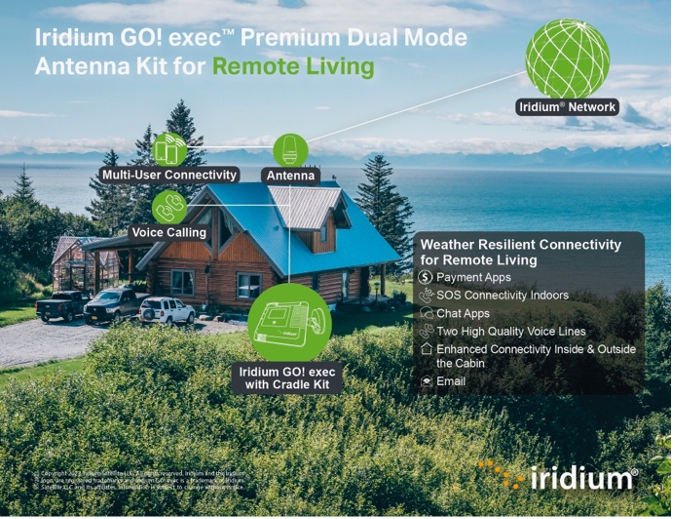
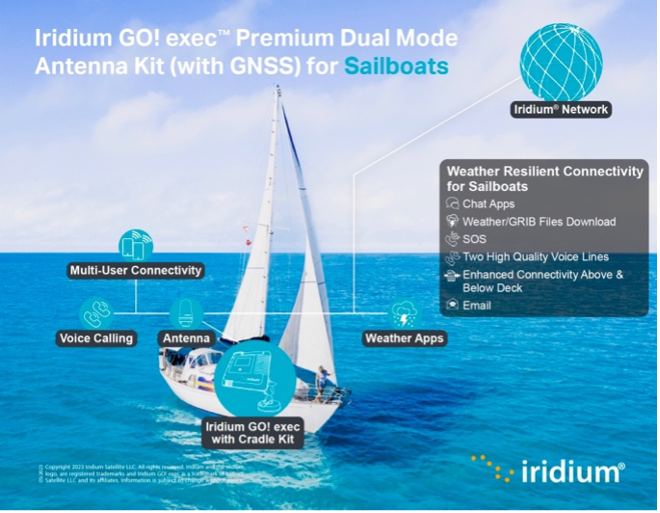
The Iridium GO! exec® external antenna kits are custom-designed to optimize a fixed-install connectivity experience for land and maritime applications.
The Premium Dual Mode kit includes a combined GNSS and Iridium® antenna, Iridium approved antenna cables, and a variety of device mounts for boats, vehicles, and fixed locations like cabins. The LITE kit offers a dedicated Iridium omnidirectional antenna, extended cable, and a fixed rail mount.
Launched earlier this year, the Iridium GO! exec operates off Iridium’s truly global network, keeping users’ favorite personal devices such as smartphones, tablets, and laptops connected anywhere in the world. With Iridium’s weather-resilient L-band network, voice calling, two-way messaging, emailing, social media posting, Internet access, and emergency SOS can all be completed, even in adverse weather conditions. This delivers the market a dependable and one-of-a-kind personal communications experience for those needing to use their own devices while outside cellular coverage.
“The high mobility and easy pole-mount installation system of the Iridium GO! exec and external antenna kits deliver a robust, portable personal device connectivity experience,” said Josh Miner, vice president, land mobile, Iridium. “A fixed external antenna kit paired with an Iridium GO! exec is a must-have for all types of remote workers, yachters, and off-grid travelers like RV’ers.”
Consumers can choose between the two external antenna kit options, one with a premium dual mode antenna, and one without GPS and similar GNSS services built in, but at a significantly reduced cost. These options allow users to choose the kit best tailored to their specific communication needs. Equipment in both kits feature an IP68 rating, ensuring durability to withstand adverse weather conditions.
Iridium® is the only mobile voice and data satellite communications network that spans the entire globe. Iridium enables connections between people, organizations and assets to and from anywhere, in real time. Together with its ecosystem of partner companies, Iridium delivers an innovative and rich portfolio of reliable solutions for markets that require truly global communications. In 2019, the company completed a generational upgrade of its satellite network and launched its new specialty broadband service, Iridium Certus®. Iridium Communications Inc. is headquartered in McLean, Va., U.S.A., and its common stock trades on the Nasdaq Global Select Market under the ticker symbol IRDM. For more information about Iridium products, services and partner solutions, visit www.iridium.com.
Press Contact:
Jordan Hassin
Iridium Communications Inc. Jordan.Hassin@iridium.com
+1 (703) 287-7421
Investor Contact:
Kenneth Levy
Iridium Communications Inc. Ken.Levy@Iridium.com
+1 (703) 287-7570
Iridium Deployed is a video series highlighting real-world applications of Iridium Connected™ devices & services.
Ecologist Dr. Jared Stabach from the Smithsonian’s National Zoo & Conservation Biology Institute talks about his research on the movement patterns of large terrestrial mammals. He also discusses how emerging technologies such as GPS tracking collars and high-resolution imagery help ecologists better understand and monitor changes occurring across the planet.
At Iridium, we know great technology is nothing without great people. In this video series, we take you Behind The Network to provide an in-depth look at Iridium’s key differentiator to becoming one of the world’s leading SATCOM providers: our team members.
Encompassing a wide range of backgrounds and experiences, employees across the company share how they joined Iridium, where their passion for their work comes from, how their role impacts the company, and more.
Let’s go Behind The Network with Kalina Leiling, MarketingManager!