Recently, Iridium supported the UK Antarctic Heritage Trust, an organization dedicated to preserving historic sites and monuments throughout the Antarctic Peninsula. In this post, guest blogger Lisa Ford, General Assistant at Port Lockroy, explains how the Iridium GO! exec® played an instrumental role in their conservation efforts.
Life at Port Lockroy in Antarctica is busy and full of all sorts of challenges but so enjoyable. There has been a lot of heritage conservation underway this year as well as the team going on and off the island most days to do pop-up shops for passengers on ships and yachts and doing presentations about the history of Port Lockroy and life on base. Work on the museum has been progressing well, and the roof beam has been repaired after it was damaged with the heavy snow on the roof last season.
Communications with the UK and ships nearby is key to enabling us to be here. Bridie Martin-West, our Base Leader, sends confirmation each day back to the UK letting the team know all is well on the island. We have been testing the various communication options, including our Iridium GO! exec equipment to enable us to contact the UK and emergency health care backup options.
We have been making sure we have time to practise our first aid emergency training skills learnt before we left the UK. We recently completed an emergency scenario, testing our skills and ensuring we all know how to use the communication equipment. All went very well. Of course, we hope we will not have to deal with any emergencies on the island.
A UK Antarctic Heritage Trust staffer at Port Lockroy uses the Iridium GO! exec to make a phone call.
Whilst we are busy, the gentoo penguins have chicks and all are growing fast. We will be on our way home in March, leaving this beautiful pristine part of the world for the gentoo chicks to finish moulting and have their adult feathers ready for their departure and eventual return next summer when the new Port Lockroy team arrives.
Thank you to all at Iridium for supporting us in this remote and unique part of the world!
MCLEAN, VA., March 18, 2024 – Iridium Communications Inc. (Nasdaq: IRDM) today announced that John McNiff has joined Iridium as Vice President and General Manager overseeing Iridium’s Space Development Agency (SDA) support, effective February 5, 2024.
In this new role, John is providing leadership and strategy for Iridium’s Space Development Agency (SDA)-related business, as it establishes the ground Operations and Integration (O&I) segment for Tranche 1 of the Proliferated Warfighter Space Architecture (PWSA). The core operations and integration functions include enterprise management, network management, mission management, payload data management, and constellation monitoring that spans the ground, link, space, and user segments of the architecture.
John joins Iridium from Microsoft Federal where he led the Intelligence Operating Unit focused on delivery of Microsoft products and services to its key national security customer vertical. With more than 30 years of experience, John has held numerous executive positions within the federal contracting industry. He spent 16 years at Northrop Grumman, holding senior executive management positions in program management, P&L operations, business development, and corporate strategy. John began his career as an engineer and product manager for commercial satellite and cellular telecommunication companies including GTE and Iridium.
“John brings a great deal of experience and expertise that will help turbocharge Iridium’s SDA operations,” said Scott Scheimreif, executive vice president of government programs, Iridium. “After having previously worked at Iridium as a product manager years ago, we’re glad his career has come full circle with him re-joining our team in this new role. We look forward to his leadership in driving smooth SDA operations and continued success.”
The Iridium team is working to operate and maintain state-of-the-art, commercial-like operations centers and ground entry points, and lead ground-to-space integration efforts. To support these growing initiatives, Iridium is continuing to hire for a variety of new roles.
About Iridium Communications Inc.
Iridium® is the only mobile voice and data satellite communications network that spans the entire globe. Iridium enables connections between people, organizations and assets to and from anywhere, in real time. Together with its ecosystem of partner companies, Iridium delivers an innovative and rich portfolio of reliable solutions for markets that require truly global communications. In 2019, the company completed a generational upgrade of its satellite network and launched its new specialty broadband service, Iridium Certus®. Iridium Communications Inc. is headquartered in McLean, Va., U.S.A., and its common stock trades on the Nasdaq Global Select Market under the ticker symbol IRDM. For more information about Iridium products, services and partner solutions, visit www.iridium.com.
Press Contact:
Jordan Hassin
Iridium Communications Inc. Jordan.Hassin@iridium.com
+1 (703) 287-7421
Investor Contact:
Kenneth Levy
Iridium Communications Inc. Ken.Levy@Iridium.com
+1 (703) 287-7570
Satellite networks can play a critical role in keeping the world’s rail transport and delivery system safe and successful.
Rail systems are key to the global economy and can contribute significantly to a country’s gross domestic product (GDP). For example, in the United States, an average of 1.6 billion tons (or 1.45 billion metric tons) of cargo is freighted on railroads every year—according to the Association of American Railroads (AAR). It’s no wonder trains need to keep moving with as few delays as possible.
To keep trains safe, on track, and able to transport people and goods on time, railway operators must have access to a reliable communications system that works everywhere. While many rail operators rely on private or cellular networks to connect centralized command and control systems to improve railroad operations and safety, there remain thousands of miles of “dark territory”: areas without ground-based infrastructure (and therefore unsupported by terrestrial communications solutions). Having a resilient communications infrastructure can help to ensure smooth operations by keeping conductors in contact with other trains and operators, enabling real-time machine health monitoring, and giving operators the ability to run diagnostic reports as needed. All these capabilities are vital to ensuring a successful route and keeping railways as safe as possible—preventing disasters like train-to-train collisions and overspeed derailments.
How is this possible? Equipping trains with reliable, global satellite communications (SATCOM) can establish complete network coverage. Let’s find out how…
What is Positive Train Control?
Positive Train Control (PTC) includes protocols and procedures implemented within a train’s operating system and designed to prevent the most dangerous and life-threatening situations while on track. According to the U.S. Department of Transportation, several of the most common occurrences include train-to-train collisions, incorrect train maneuvers due to switches being left in improper positions, overspeed derailments, and incursions into established work zones. Equipping a train’s PTC with SATCOM technology helps to ensure that no matter where the train travels, a reliable connection will be available and important data points will not be missed.
Getting From Point A To Point B: Track Sensors & Crew Communications
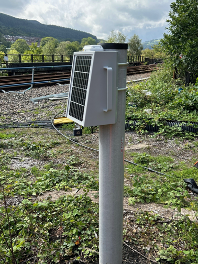
Satellite networks can enable more than just a train’s PTC system. Track sensors and conductor communications, two of the most critical components to train operations, can utilize satellite networks to transmit critical data and enable onboard communications for crew safety. Track sensors enabled by satellite networks can transmit vital safety information such as remote rail condition monitoring, including temperature and obstruction detection to warn of potential hazards. Sensors can also be deployed in flood and mudslide-prone areas to convey track condition changes that can prevent accidents, improving safety and reducing operational costs.
Radio Data Networks track-side wireless satellite gateway. Image credit: Radio Data Networks Limited.
For example, Radio Data Network’s battery-powered Rail Monitoring Solution, enabled by Iridium’s satellite network, captures real-time data of a track’s temperature and can be installed anywhere. This gives train conductors and rail control centers forewarning of any potential rail buckling due to extremely warm temperatures, or ice due to exceedingly cold temperatures, anywhere along the tracks. As important as all this sounds, the information being collected is only useful if it is quickly delivered to the correct people. With many sensors placed alongside tracks in areas located far beyond cellular coverage, satellite networks are the key ingredient to ensuring this important safety capability stays connected and information gets where it needs to go.
Radio Data Networks sensor/transmitter assembly mounted to the foot of the rail on an insulator clip. Image credit: Radio Data Networks Limited.
How Does SATCOM Provide Trains With Complete Network Coverage?
It may come as a surprise, but only about 15% of the world has cellular coverage. This means rail networks traverse a lot of uncovered areas. When a train is out of cellular coverage, satellite communications fills the gap—serving as the link between a train’s PTC system, the conductor’s communications with railway stations, remote track sensors, and the operator’s command center.
Satellite networks provide connectivity in areas of the world that cellular networks don’t view as worthy of significant infrastructure investments. Whether it’s a cellular network or a private rail system network, the costs to build and maintain these networks are difficult to justify relative to the costs associated with SATCOM.
SATCOM terminals are increasingly affordable, available commercially off-the-shelf, and are simple to install on a train. Iridium, for example, offers low-latency, weather-resilient global connectivity via its crosslinked Low Earth Orbit (LEO) satellite constellation.
Trains equipped with Iridium Connected™ PTC technology and crew communications systems can stay connected along their remote routes, giving operators and technicians real-time information about the assets they are delivering. Iridium Connected track sensors offer a weather-resilient, small-form-factor solution for receiving critical safety data that can be discreetly placed and doesn’t suffer from the look-angle challenges in mountainous or high-latitude regions faced by geostationary networks. Additionally, rail applications that run over Iridium Certus® offer all the mentioned benefits of Iridium’s network in a variety of speed class options. User requirements can be tailored to their data needs.
Working in the maritime industry is not for the faint of heart. Commercial shipping and fishing vessel crews are vulnerable to natural elements, the isolation of the open seas, and—in some regions—the possibility of piracy incidents. The Iridium® Global Maritime Distress and Safety System (GMDSS) was created as a safety mechanism for these threats, serving as a communications lifeline for vessels in distress.
Kyle Hurst, Iridium’s Director of Maritime Safety and Security Services, recently joined Digital Ship, one of the largest and most influential maritime publications, to discuss several service developments made to Iridium GMDSS and how they’re benefiting maritime communications and crew safety across the globe.
The Three “Seas”: Iridium GMDSS Benefits
Traversing the open seas requires a truly global network, and with its ecosystem of world-class partners, Iridium maritime safety equipment is designed to keep fleets safe and connected, no matter where they are in the world.
Hurst describes the key benefits of the Iridium GMDSS as the “three Cs” (or “Three Seas”—if you’re into puns):
Cost
“Having improved technology at a lower cost helps maritime safety in general,” Hurst notes. A lower cost means higher accessibility so more fleets can be equipped with Iridium GMDSS. The inaugural Iridium Conntected™ GMDSS terminal, the Lars Thrane LT-3100S, supplies all satellite GMDSS services with Iridium’s additional features for around a quarter of the cost of competing equipment requirements.
Iridium GMDSS is the only system with safety voice capabilities.
“The phone call is key,” Hurst explains. “Knowing the nature of the distress, how many people are on board, and what the crew is doing allows the Rescue Coordination Center [RCC] to understand more about what’s going on and design an appropriate response.” Learn more about RCCs.
Iridium GMDSS also connects crew members to medical professionals for immediate assistance in emergencies.
Charting A New Path
Hurst described Iridium’s recent maritime performance, noting the company has seen “solid growth in activations and installation over the first three quarters of 2023, demand well above 2022 numbers.”
Around 20% of vessels have installed two Iridium GMDSS terminals for built-in voice redundancy.
“We have seen a lot of shipping companies moving toward Iridium GMDSS,” Hurst said, describing a significant shift from passive to active implementation strategies, meaning more companies are switching working terminals for Iridium GMDSS rather than just replacing terminals on failure.
With the wind of these successes in its sails, Iridium is gearing up for the anticipated release of GMDSS over Iridium Certus® in late 2024.
“In my view, you’ll have the fastest L-band broadband terminal with the most technologically advanced GMDSS all combined in one package,” according to Hurst.
Iridium has also launched its GMDSS Academy—a comprehensive curriculum designed for maritime academies and students. The three-module training includes up-to-date resources on the Iridium network and its evolving performance, Iridium GMDSS service capabilities, the latest equipment developments, and insights on how Iridium GMDSS can make a critical difference in maritime safety operations.
By Michelle Houchins, Iridium Diversity & Inclusion Council member and Engineer
Every March, we celebrate Women’s History Month and International Women’s Day. These celebrations are an opportunity to not only honor the extraordinary achievements of women, but to recognize the work that still needs to be done to achieve gender equality.
International Women’s Day traces its roots back to 1908 in New York City, where female factory workers united together to protest poor working conditions. The following year, the National Socialist Party of America established the first National Women’s Day to honor these courageous factory workers. It wasn’t until 1917, when women were granted the right to vote by the Provisional Government of Russia, that International Women’s Day became a national holiday celebrated on March 8. Over the years as the international women’s movement grew, more countries began celebrating International Women’s Day. In 1977, the United Nations officially recognized International Women’s Day as a holiday.
The story of Women’s History Month begins in the city of Santa Rosa, California. In 1978, the women of Santa Rosa organized the very first Women’s History Week. Discontented with the lack of women’s history in K-12 curriculum, these women designated the week of March 8 to highlight the contributions of women in American history. The week was full of special activities in schools, a nationwide “Real Woman” essay contest, and even a celebratory parade held in downtown Santa Rosa, California. The following year, other communities followed suit and put on their own Women’s History Week festivities. In 1980, President Jimmy Carter proclaimed the week of March 8 as National Women’s History Week. When Congress passed Public Law 100-9 in 1987, March finally became designated as Women’s History Month.
You are currently browsing the IFP blog archives for March, 2024.