To celebrate Iridium’s 25th anniversary, we’re reflecting on the eras that made the company what it is today. From its iconic inception to infamous bankruptcy to its rise from the ashes, learn more about the world’s first and only truly global satellite network.
Ruh Roh.
Soon after activating the Iridium® network in November 1998, Motorola realized the numerous challenges they faced. The Iridium project was an idea ahead of its time. Creating the world’s first truly global network sounded like it would be a highly-sought-after service for voice and data needs—and it was—but not for the customer initially intended.
When the Iridium constellation was first built, the belief was the network would be used by international business travelers. Having the ability to call anyone from anywhere on the planet sounded great. At the same time, the lighter, smaller, and cheaper cell phone rapidly grew in service availability in the places people most often were: towns and cities. This led to the start of trying times for Iridium.
After financing such a large space technology project that involved 20 launches, Iridium needed to reach one million network subscribers in its first year to keep operations running. Nine months after launching its service, Iridium had only 62,000. After not seeing the return expected from customers less than two years after launching its service, Iridium found itself in bankruptcy court with a small group of investors doing anything possible to take over the network and prevent its fiery deorbit. If not for them, the Iridium we know today would not exist.
Back From the Brink
After nearly facing the deorbiting of its satellites in December of 2000, the reborn Iridium’s eventual first CEO, Dan Colussy, and other notable investors secured a two-year, multimillion-dollar contract with the U.S. Department of Defense (DoD). The partnership officially marked Iridium’s territory in the telecommunications industry and gave leaders the time needed to put together a new commercial market approach. Instead of focusing on the international business traveler, the newly formed leadership targeted specific markets where cell towers could not exist but reliable communications were essential. Vast areas of the Earth—including the oceans, airways, mountain ranges, and polar regions—had little to no connectivity until Iridium. This gave the company a sound business plan to launch its service and products into a largely untapped market.
Experienced leaders and investors from around the industry wanted to join the company’s newfound beginnings when Iridium relaunched its commercial service in 2001. Just two years later, the DoD renewed its service contract for another year while Iridium introduced the first iteration of Iridium Short Burst Data® (SBD®). After finally finding its footing on the commercial side of the communications industry, Iridium passed its next milestone by surpassing 100,000 commercial subscribers in 2003.
Once Colussy and others fought to bring Iridium out of the bankruptcy, the technology landscape had already begun to shift. It didn’t take long before the satellites originally launched with an expected design life of approximately seven years needed a plan for their replacement if the network and company were to survive. Just a few years later, in 2006, leadership was transferred to a new CEO, Matt Desch, and a new era of Iridium was about to unfold.
To celebrate Iridium’s 25th anniversary, we’re reflecting on the eras that made the company what it is today. From its iconic inception to infamous bankruptcy to its rise from the ashes, learn more about the world’s first and only truly global satellite network.
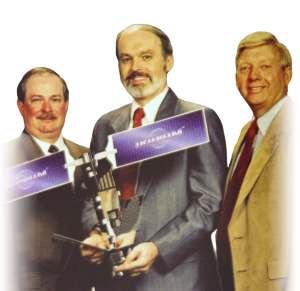
In 1987, a few bold thinkers envisioned a revolutionary system of communications. Bary Bertiger, Ray Leopold, and Ken Peterson met working as engineers at Motorola. Although cell phones existed, they were not yet ubiquitous, and spotty cell service was a huge issue. The group began brainstorming how to create a phone that would work everywhere in the world. As the inventor of the first handheld mobile phone, the DynaTAC, Motorola was well positioned to solve that problem. Instead of building cell towers across the entire planet, the group thought: Why not put those towers in the sky?
Motorola Strategic Electronics Division engineers Bary Bertiger, Ken Peterson, and Ray Leopold
Their proposal did not go without objections and setbacks. Many of Bertiger, Leopold, and Peterson’s colleagues did not see the importance and for a time it was a passion project they dedicated hours to outside of work. Critics raised dozens of concerns ranging from size, cost, and corporate approval to sheer feasibility. Despite this, the project captured the imaginations of those who were involved, and the naysayers motivated them even further.
Once the idea was formally approved, it expanded to a Motorola research lab in Arizona, built partially based on technology developed for U.S. President Ronald Reagan’s abandoned Strategic Defense Initiative (dubbed “Star Wars”). The group brainstormed ideas other than satellites, including fleets of planes and balloons. Upon deciding on satellites, their next dilemma was where the satellites should deploy. The architecture of the network called for a polar orbit and for the satellites to be as close to earth as possible, making Low Earth Orbit (LEO) the perfect fit.
The constellation was originally expected to need 77 satellites to provide global coverage, making Iridium—the element with an atomic number of 77—the ideal name due to the system’s design resembling electrons (the satellites) orbiting a nucleus (the Earth). Engineers later discovered only 66 satellites were necessary to cover the Earth, but the element Dysprosium didn’t have quite the same ring to it, so the name Iridium endured.
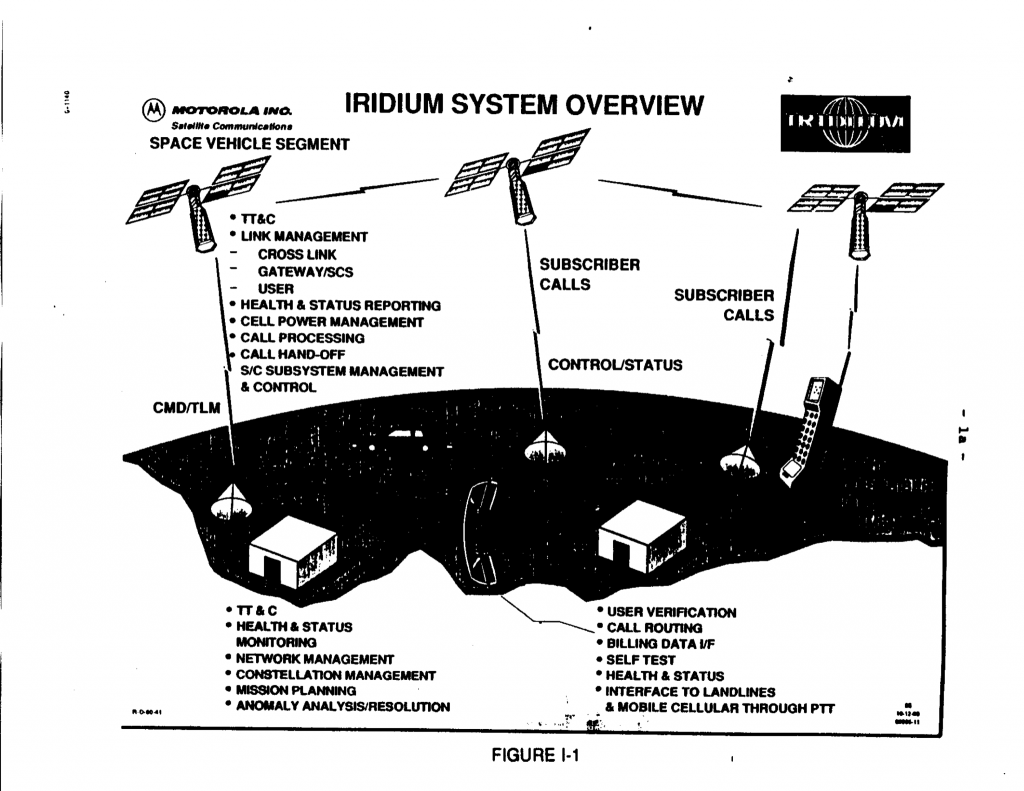
Original Iridium System Overview
Over the next decade, more than 90 satellites were built and launched. At the time, the Iridium® satellite constellation was the largest to be put into space, and the most complex engineering project in history. After 20 successful launches in 13 months, Iridium’s cross-linked, autonomous, and global network was fully operational.
Iridium announced that the world’s first global handheld satellite phone and paging system was commercially available on November 1, 1998. The inaugural call was a symbolic moment, with U.S. Vice President Al Gore dialing up Gilbert Grosvenor, Chairman of the National Geographic Society and great-grandson of Alexander Graham Bell – best known for his invention of the telephone – ringing in the next revolution of communication.
In honor of National Hispanic Heritage Month, Iridium team members share what the month means to them and from where they draw their inspiration and motivation.
Q.: May you share how you chose your profession and how you ended up in your role at Iridium?
A.: I started working in Telecom in 1996 for a carrier in Puerto Rico. I was brought on to a team implementing new business systems and telecom networks as additional properties or licenses were purchased. I had the opportunity to work on projects in the Dominican Republic, Jamaica and across some markets in the US. I came to Iridium for these same reasons. As a telecommunications company we have a unique network, but the back office and business systems are very alike in that they always need improving and finding efficiencies for our customers internal and external alike.
Q.: What does National Hispanic Heritage Month mean to you?
A.: It’s a celebration of our cultures, plural. Although many Hispanic and Latino cultures are similar, we also have differences in how we celebrate and when. I was born in New Jersey but raised in Puerto Rico. Although an island of the US, we are very much our own and proud of it.
Q.: What has been your biggest inspiration / motivation?
A.: My family, my wife and two daughters. Everyday! I was also raised by some of the strongest women I know: my grandmother, mom, and aunt. Watching them work hard is something I still think about and remember as often as I can.
Maria De Los Santos – Associate Director, Accounting
Q.: Can you share how you chose your profession and how you ended up in your role at Iridium?
A.: When I was growing up, I watched my mother meticulously keep track of household income and expenses in a spiral notebook. Even though she only had a 6th grade education, she was very intelligent and an excellent money manager. I attribute my interest in accounting to her.
I was recruited for a staff accountant position at Iridium 16 years ago and it has been such a great adventure to experience all the changes at Iridium in that time, from becoming a public company to launching a new constellation to growing from a company of 123 employees to almost 800!
Q.: What does National Hispanic Heritage Month mean to you?
A.: It is a time to reflect on the achievements of Hispanic and Latino people who have achieved so much despite the barriers they have had to break. For example, Ellen Ochoa, who was the first female Hispanic astronaut, and Jose Hernandez, a Latino astronaut who grew up in a family of migrant farm workers (there’s a movie about his life called A Million Miles Away).
Q.: What has been your biggest inspiration / motivation?
A.: My parents were my biggest inspiration. Neither had education beyond 6th grade, and they came from Mexico with nothing. Yet, throughout our childhood, they emphasized the importance of education and ingrained in their three children that education is the one thing nobody can take away. When we were children, homework was the single most important job in our home, superseding chores and everything else. They accomplished so much by working extremely hard and setting high expectations for their children.
Luis Ortiz – IT Security Analyst
Q.: Can you share how you chose your profession and how you ended up in your role at Iridium?
A.: I’ve always been a tinkerer. When I was in middle school, I would take the family desktop apart and put it back together for fun, even breaking it in the process more than once. Regarding my role at Iridium, I started at the service desk a few years ago while I was finishing my bachelor’s degree in Cybersecurity. I’m thankful to have had the opportunity to transition into the team and learn from such a diverse and experienced group.
Q.: What does National Hispanic Heritage Month mean to you?
A.: National Hispanic Heritage Month is an annual celebration dedicated to recognizing and celebrating the contributions, culture, and history of Hispanic and Latino Americans. It’s Junot Diaz bringing magic realism to the English language. It’s about figures like Sonia Sotomayor, who have left an indelible mark on the history of the United States, and icons such as Selena Quintanilla, whose legacy continues to inspire the likes of Jennifer Lopez, showcasing how these extraordinary individuals have contributed to and influenced American society.
Q.: What has been your biggest inspiration / motivation?
A.: As a first-generation American, my family has always been a huge inspiration. My parents migrated here to provide my brothers and me with better opportunities. So, naturally, I thank them for shaping the person I am today. It’s due to their sacrifices that I can provide for my own family, which has recently grown by one with the addition of my daughter, Camila, who has become my motivation to continue improving myself.
I’d like to also mention two other people who have been recent inspirations. Eric J. Belardo, the founder and Executive Director of RaicesCyber.org, has been an inspiration. Eric created Raices to help the Latino community break into the notoriously challenging field of Cybersecurity. The second person who has inspired me is my best friend, Luis Inarra. Despite facing what at times seemed like insurmountable odds, he graduated at the top of his class and is currently practicing law in the state of Alabama. These two gentlemen face adversity head-on and welcome challenges with a smile. I admire them both and consider myself fortunate to know them.
Every summer, Iridium® interns make a truly global difference in a variety of roles ranging from engineering, computer science, astrophysics, business, human resources, marketing, finance and more. Learn more about Bharath Kumar Nagalamadagu Govindaraju, Radio Frequency (RF) Engineering Intern in this Q&A.
Can you please introduce yourself and tell us more about your internship at Iridium?
My name is Bharath Kumar Nagalamadagu Govindaraju, and I am a graduate student at George Mason University, specializing in Internet of Things (IoT) and Network Security. I have worked as an IoT and Electronics Engineer for three years and tend to focus on socially unconventional projects that address real-time issues people face.
With a passion for IoT, I was elated to join the innovative team at Iridium as an RF Engineering intern in the Iridium Certification group under the guidance of Senior Engineering Manager, Omid Nia. The company’s reputation for pushing boundaries and fostering a culture of creativity and excellence resonated deeply with my aspirations. Little did I know that this summer would exceed my expectations, opening doors to hands-on learning and collaboration that would leave an indelible mark on my professional journey.
From the onset, I learned about the complexities and intricacies of satellite communications (SATCOM) and IoT through captivating projects. Guided by experienced mentors, my responsibilities required analytical thinking and creativity.
Can you share more about the Iridium Connected™ product you created this summer? What does it do, and what motivated you to pursue this project?
Ever since I was young, I have been interested in agriculture and have had various connections to it, both directly and indirectly. The challenges faced by the agriculture industry and how to overcome them have always been fascinating to me. One of the most pressing issues in the field is the depletion of soil nutrients due to overuse, which can lead to erosion and lower yields.
Climate change has also brought about unpredictable weather patterns, which can negatively affect crop growth and result in crop failure. Additionally, water scarcity, pests, and diseases are all significant challenges that farmers must contend with, often resulting in lower crop yields and income losses for farmers.
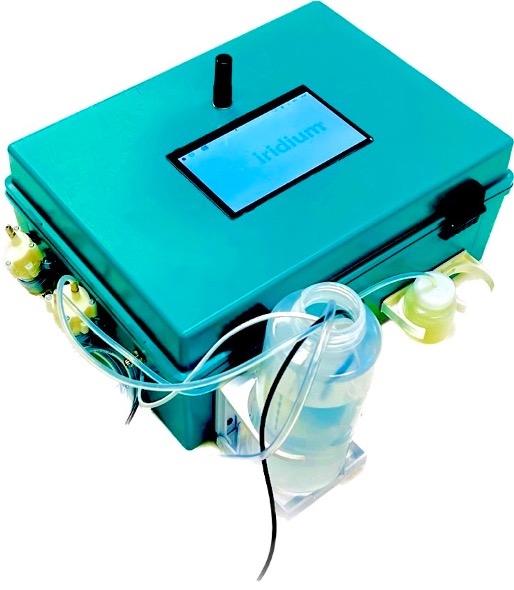
During my internship at Iridium, we developed a prototype to help solve all these problems, based on the concept of precise and scientific farming methodologies for efficient usage of resources. Iridium’s Agronomical Management System—also known as Green Box—constantly monitors the whole process in which we have segregated the vital elements of farmland into three different ways:
Environment Management System
Consists of a DHT11 sensor, which captures the temperature and humidity of the surroundings.
Water Management Sensors
Includes pH, Total Dissolved Solids (TDS), and water temperature sensors, which are essential for assessing water’s cleanliness and overall quality.
Soil Management Sensors
Soil moisture sensors automate water pumping.
Maintaining optimal soil moisture levels is vital for healthy and hydrated plants, so regularly monitoring the moisture content of the soil is critical to promoting optimal plant growth.
Take note of any dry soil areas and water them thoroughly, keeping a close eye on the moisture levels to ensure they remain consistently moist.
Iridium’s Agronomical Management System, aka Green Box
The microprocessor is linked to all the sensors and pumps, including the Iridium 9603 Module. The pH of water is checked at regular intervals, and in case of any abnormalities, the pH buffer solution is pumped to bring it back to the necessary pH level. The status of all sensors and devices is constantly monitored, and the data is transmitted to the Iridium satellite network and received at the designated IP address.
Using Iridium’s satellite communication services, this product can be installed anywhere on Earth, providing convenience and accessibility for users worldwide. Its portability simplifies the installation process and ensures that users can easily set it up without any hassle. Whether in a bustling city or a remote location, this product can be easily installed and put to use. Its versatility and reliability make it a valuable tool for individuals and businesses.
What is something you’ve taken from your internship at Iridium?
The guidance and mentorship I received at Iridium were integral to my growth. The open-door policy encouraged candid conversations where I could seek advice, discuss challenges, and explore opportunities. These interactions fine-tuned my technical skills and provided a glimpse into the art of thriving in a dynamic work environment.
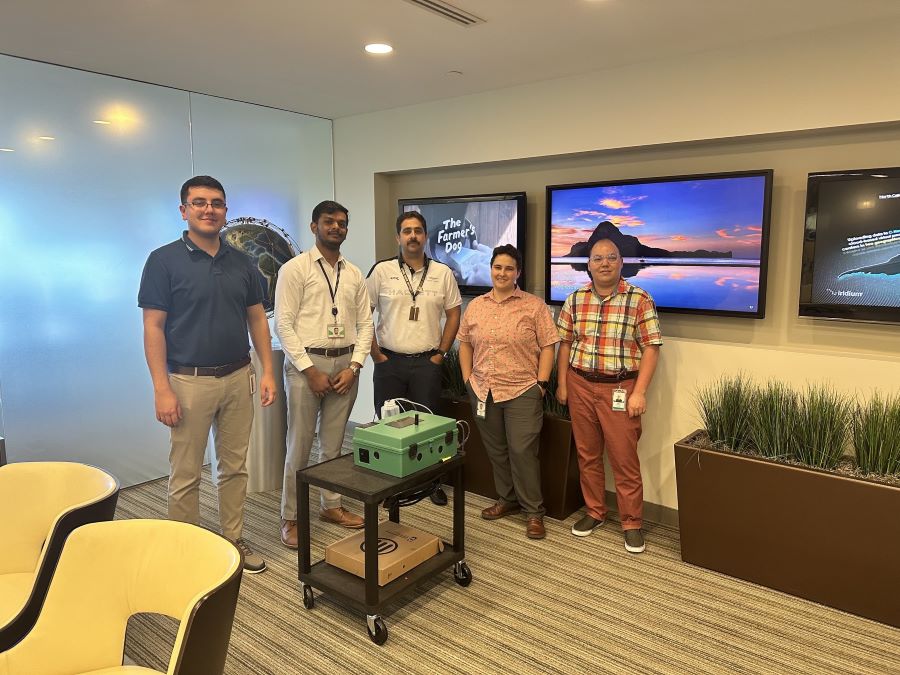
Bharath with members of Iridium’s engineering team
Reflecting on my summer at Iridium, my gratitude is boundless for its profound impact on me and my career. The exposure to cutting-edge technologies, the camaraderie of brilliant minds, and the culture of perpetual learning have equipped me with tools to navigate the ever-evolving landscape of RF Engineering and SATCOM.