At Iridium, we know great technology is nothing without great people. In this video series, we take you Behind The Network and provide an in-depth look at Iridium’s key differentiator to becoming one of the world’s leading satcom providers: our team members.
Encompassing a wide range of backgrounds and experiences, employees across the company share how they joined Iridium, where their passion for their work comes from, how their role impacts the company, and more.
Let’s go Behind The Network with Mali Vander Leest, Space Vehicle Software Engineer!
Unattended sensors are everywhere. Nearly every industry uses them, and nearly every user has the same requirements: they need them to be on and working, no matter what. Deploying unattended sensors requires a lot of trust in the communications systems that keep the sensors connected and operating. Key requirements like global coverage, high reliability, weather resilience, and a fast connection can only confidently be met by adding satellite communications (SATCOM) to the mix.
To paint a picture of the critical role SATCOM plays in connecting unattended sensors, it is important to understand what they are and how they’re used.
What Are Unattended Sensors?
Unattended sensors serve as the unsung heroes of the autonomous world. They are primarily used to capture and disseminate critical data on a 24/7 basis and have a rugged design, meant to withstand the elements for long periods of time—even decades—without human intervention. Unattended sensors are often deployed in remote areas where cellular connectivity is minimal or nonexistent, underscoring the importance of having access to a SATCOM solution to use as a primary or backup connectivity option.
The Iridium® network is uniquely qualified to connect unattended sensors, being the only network that delivers truly global coverage. Each satellite is connected to its neighboring satellites via crosslinks creating a web of coverage around the entire planet. Additionally, its location in Low Earth Orbit (LEO) delivers a fast, low-latency connection, while its L-band frequency provides a reliable and weather resilient signal, which are ideal network characteristics for providing connectivity to unattended sensors.
How Do Unattended Sensors Work?
Remote unattended sensors fall under the satellite Internet of Things (IoT) umbrella. They are typically small form factor devices that are deployed across remote environments. Unattended sensors can serve as standalone units or can be attached to an object (ex: a piece of equipment). These sensors can be programmed to monitor an activity, send alerts when a specific threshold has been reached or triggered, provide a status update or track a specific process. Once the sensor has collected the data, it shares that information with the end user on a routine basis.
Satellite IoT technology developers are able to create a variety of unattended sensor solutions over the Iridium network to meet any project connectivity requirement. There are options to leverage solar power for in-field deployments with off-the-shelf solutions like Iridium Edge® Solar, and ways to incorporate edge computing to ensure only the most important data is being communicated, which can help manage costs and increase efficiencies.
Iridium’s satellite IoT solutions and devices are purpose-built for low power, low energy, low cost, and long deployment project lifecycles. There are many developer resources and various modalities to integrate with the network including Iridium IoT terminals and modules, and options to develop around Iridium core technology to build new applications.
Use Cases
Unattended sensors are deployed by a variety of industries all over the world in some of the most hazardous environments. Whether it’s a utility company monitoring pipelines, a remote weather station tracking severe storms, railway track condition sensing and monitoring, or tsunami warning buoys, these sensors are everywhere and are helping to make a positive impact on our planet.
For example, agricultural businesses rely on unattended sensors to monitor environmental changes across vast and remote farmlands throughout Latin America. Additionally, conservationists deploy unattended sensors to monitor changes to ecosystems like melting ice caps and glaciers and are also using them to track migration patterns of endangered species like the Adelie penguin population in Antarctica.
The United States Government is a major user of unattended sensors, including both unattended ground sensors and unattended sensors in maritime environments. The USG primarily uses unattended ground sensors to minimize human exposure to dangerous situations. While these sensors are deployed for standard tracking uses, they are also used for persistent sensing applications that capture data for safety of life purposes.
For instance, Iridium partner McQ offers multiple unattended ground sensor solutions for military and commercial use. These sensors are small, rugged devices that can be stealthily deployed (some versions can even be air dropped) into locations that are too dangerous for humans. McQ unattended sensor technology can monitor the acoustics of an area and differentiate between animal, vehicle, and human sounds. This technology can also track seismic and magnetic sensing data and can characterize a specific object and identify the direction it is moving. These devices can be used for secure military operations like tracking footpaths and can send information in multiple formats including data messages, photos, and videos.
The United States Department of Interior also relies on unattended ground sensors to track water levels, levees, and other infrastructural elements to monitor degradation and prevent disaster events. Iridium partner Intellisense offers a solution called the AWARE Flood Sensor that tracks flood waters and provides warning signals to first responders about flood prone areas.
There is a lot to share about this world, and what we’ve covered above is only the tip of the iceberg. By using SATCOM to connect unattended sensors, companies and organizations from nearly all industries are able to monitor and collect data about nearly anything, from anywhere.
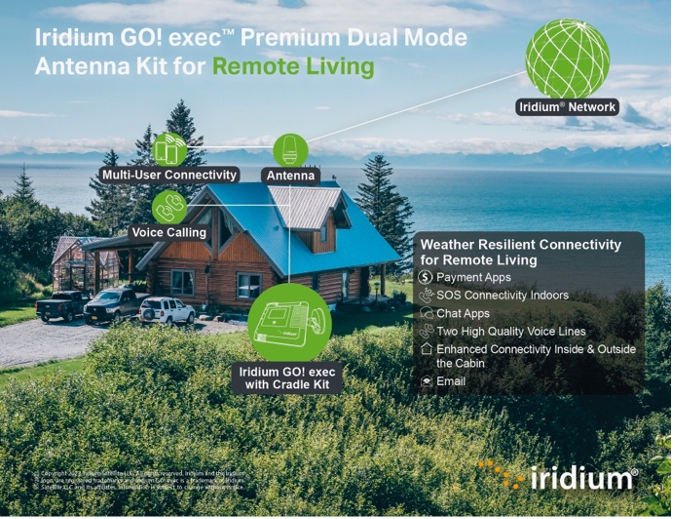
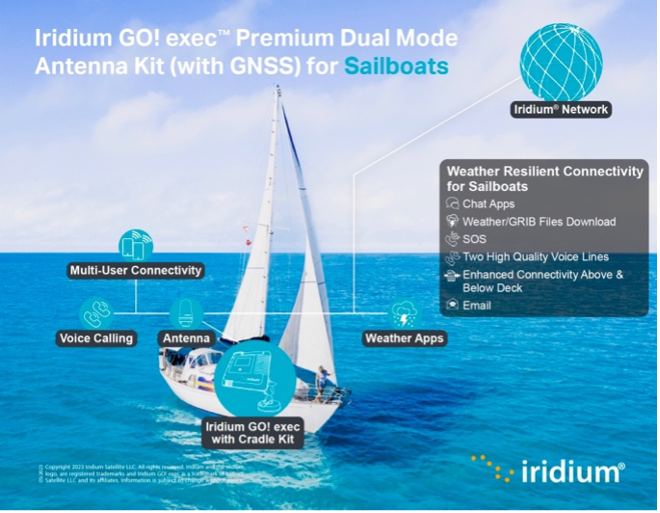
The Iridium GO! exec® external antenna kits are custom-designed to optimize a fixed-install connectivity experience for land and maritime applications.
The Premium Dual Mode kit includes a combined GNSS and Iridium® antenna, Iridium approved antenna cables, and a variety of device mounts for boats, vehicles, and fixed locations like cabins. The LITE kit offers a dedicated Iridium omnidirectional antenna, extended cable, and a fixed rail mount.
Launched earlier this year, the Iridium GO! exec operates off Iridium’s truly global network, keeping users’ favorite personal devices such as smartphones, tablets, and laptops connected anywhere in the world. With Iridium’s weather-resilient L-band network, voice calling, two-way messaging, emailing, social media posting, Internet access, and emergency SOS can all be completed, even in adverse weather conditions. This delivers the market a dependable and one-of-a-kind personal communications experience for those needing to use their own devices while outside cellular coverage.
“The high mobility and easy pole-mount installation system of the Iridium GO! exec and external antenna kits deliver a robust, portable personal device connectivity experience,” said Josh Miner, vice president, land mobile, Iridium. “A fixed external antenna kit paired with an Iridium GO! exec is a must-have for all types of remote workers, yachters, and off-grid travelers like RV’ers.”
Consumers can choose between the two external antenna kit options, one with a premium dual mode antenna, and one without GPS and similar GNSS services built in, but at a significantly reduced cost. These options allow users to choose the kit best tailored to their specific communication needs. Equipment in both kits feature an IP68 rating, ensuring durability to withstand adverse weather conditions.
Iridium® is the only mobile voice and data satellite communications network that spans the entire globe. Iridium enables connections between people, organizations and assets to and from anywhere, in real time. Together with its ecosystem of partner companies, Iridium delivers an innovative and rich portfolio of reliable solutions for markets that require truly global communications. In 2019, the company completed a generational upgrade of its satellite network and launched its new specialty broadband service, Iridium Certus®. Iridium Communications Inc. is headquartered in McLean, Va., U.S.A., and its common stock trades on the Nasdaq Global Select Market under the ticker symbol IRDM. For more information about Iridium products, services and partner solutions, visit www.iridium.com.
Press Contact:
Jordan Hassin
Iridium Communications Inc. Jordan.Hassin@iridium.com
+1 (703) 287-7421
Investor Contact:
Kenneth Levy
Iridium Communications Inc. Ken.Levy@Iridium.com
+1 (703) 287-7570