Earlier this year, The Ocean Cleanup went viral in the news and on social media for its ambitious goal to rid the world’s oceans of plastic garbage and perform the largest ocean cleanup in history.
The Ocean Cleanup has created a system of 600-meter-long floating plastic collectors that include a 3-meter-deep skirt designed to collect plastic pollution. Through a combination of the wind, waves, natural ocean currents, the system is able to capture waste and prevent plastic from escaping underneath or flowing over the top, and can avoid harming sea life.
According to The Ocean Cleanup’s website:
“Over 5 trillion pieces of plastic currently litter the ocean. Trash accumulates in 5 ocean garbage patches, the largest one being the Great Pacific Garbage Patch, located between Hawaii and California. If left to circulate, the plastic will impact our ecosystems, health and economies. Solving it requires a combination of closing the source, and cleaning up what has already accumulated in the ocean.”
The first system, System 001 (a.k.a. “Wilson”), launched into the Great Pacific Garbage Patch in early September, and the company estimates that a full-scale system roll-out could clean 50 percent of the Great Pacific Garbage Patch every five years.
On the heels of System 001’s launch in the Pacific, Iridium announced participation in the project as the preferred provider of satellite communications for The Ocean Cleanup. We are working with The Ocean Cleanup team and one of our value-added partners, The AST Group, to support the cleanup mission with Iridium® L-band satellite broadband services.
“Wilson” is equipped with two Iridium Pilot® terminals providing the Iridium OpenPort® broadband service, which allows the autonomous system to relay critical systems data back to the team in Rotterdam, including compartment flood detection, position and location information, pictures (like the one to the right), 360-degree video, and system performance information. As The Ocean Cleanup team scales up the project to 60 systems, Iridium and AST will continue to support the mission with terminals and service, and plan to begin providing Iridium CertusSM hardware and services once it becomes available.
For more information about The Ocean Cleanup, visit www.theoceancleanup.com. Check out the video below to learn more about Iridium’s involvement in the project!
Guest Blogger: Will Kraus, Director, Maritime Business & Product Management
Frequently, maritime service providers will talk about bandwidth – bigger bandwidth equals a better user experience. Whilst some of this is true, latency can have a more dramatic effect upon the perception of how fast a network connection actually is. You may have experienced webpages loading slowly on a public Wi-Fi network, despite your laptop/phone reporting that the Wi-Fi link is fast – this is a similar effect to a high latency connection. Crew members on a ship often complain about the Internet speed, with both over-use and high latency causing frustration. Over-use of a satellite link can be managed, but the physics of transmitting a signal from a vessel 36,000km cannot be overcome. Remember, captain, ‘Ye cannae change the laws of physics”!
Latency describes the amount of time it takes for a data packet to be transmitted and returned back to its source. The total time for the round trip is known as latency and is normally expressed in milliseconds (ms). For example, your LTE mobile phone will have a latency of about 20ms compared against a geosynchronous L-band satellite with 1,100ms. A maritime VSAT service would typically experience around 700ms latency. Higher latency figures can play havoc with applications that communicate over networks. If an application is not optimised for satellite communications, it can lead to retransmission of data packets. This in turn makes data communications less efficient, perhaps increasing costs in particular on volume-based plans (e.g. 1GB per month). Additionally, some network applications require the link’s latency to be under a specified time.
Optimisation of the ship’s Wide Area Network (WAN) satellite links can both improve the user experience of browsing and provide management of data traffic passing over the link. For example, classifying outbound network traffic with a priority allows the satellite modem to determine which data should be sent first. This allows for time critical applications and services to pass over the satellite link first, with lower priority traffic such as crew Internet browsing waiting its turn. Restricting which traffic is allowed to pass over the satellite link is also recommended, as operating system updates can be very large. Many service providers have smart boxes that can automatically perform these tasks, and allow only desired applications and services onto the WAN link.
Working hand in hand with our Service Provider (SP) network, Iridium ensures that the Iridium CertusSM service is always optimised. Our Low-Earth-Orbit (LEO) network’s latency is greatly reduced compared to Geostationary (GEO) satellite constellations. When combined with our inter-satellite links, the net effect is lower latency with less packet retransmission, making Iridium® more attractive for applications with critical timing requirements.
Join us this Fall in getting out and trying new adventures! Not sure where to start? We’ve got some tips for you.
With the holidays and winter rapidly approaching, now is the perfect time to get out and take advantage of the cool crisp air before it gets too cold to enjoy! In this installment of our First Time Fall Adventurer series, learn what to consider before heading out on a bike trip!
Select Your Terrain
Singletrack is the most common trail type. Its width ranges from just a little wider than your shoulders to a track that’s wide enough for two bikes to pass each other. Many singletrack trails are open to one-way travel and wind their way through beautiful views.
Doubletrack trails are usually twice the width (or more) of a typical singletrack trail, giving you enough space for two bikes to ride next to each other. Often these trails were created by vehicle tires, meaning that this type of trail may follow along abandoned logging roads, fire roads, or power-line roads. These trails also usually have a gentler grade than singletrack, which may make it best for beginner bikers.
Mountain bike terrain parks are a fun and increasingly common trail type – appearing everywhere from under urban overpasses to ski resorts. This trail type often has features like elevated bridges, halfpipes, jumps of various sizes, berms, banked corners and hairy downhill switchbacks.
Determine your Biking Style
Trail:This is the most common mountain biking style – and considered “the fun one”! If you want to bike with friends or try out different climbs and descents, this biking style is perfect for you.
Cross-Country: This style of riding typically implies riding fast, with an emphasis on climbing. This is a great biking type if you’re thinking about getting involved in competitive biking or just want a more adventurous ride.
All-Mountain/Enduro:This type of biking is similar to trail riding, but is much more intense! Think of leg-burning climbs, white-knuckle descents, and more technical features—both man-made and natural.
Downhill/Park:This type of riding is mostly available at lift-serviced bike parks. You ride tough bikes and wear full-face helmets and body armor as you ride over jumps, berms, rock gardens, and wooden ladders – and you’re descending the whole time! There’s not much pedaling since gravity does the work, but you’ll still get a great workout since you’re constantly reacting to the terrain!
Pick Your Bike
Rigid: Rigid bikes are easy to maintain and usually less expensive, but don’t have any suspension, which some riders find uncomfortable. Some riders choose rigid “fat bikes” which have wide tires and low pressure to absorb bumps in the trail.
Hardtail: These bikes have suspension that absorbs impact on the front wheel, but the rear has no suspension, giving this type of bike its name – hardtail. These bikes tend to be less expensive than full-suspension bikes, and have fewer moving parts, meaning they require less maintenance. Most hardtail bikes also have the ability to lock the front suspension fork, allowing you to turn it into a rigid bike when desired.
Full Suspension:This type of bike is built to absorb the impacts of the trail, reducing the impact on your body, increasing traction, and making for a more enjoyable ride.
Learn more about what to consider and how to pick the best bike for you by clicking here.
Safety First
Trail bike rides usually take longer than you think, especially on trails with more rugged terrain. Make sure to pack more food and water than you think you need.
Make sure to carry the tools you may need – a spare tube, a hand pump, and a small multi-tool.
You might not have cell phone service on the trails if you need help or encounter a medical emergency. It’s a smart idea to bring a satellite-enabled emergency device. Many Iridium partners offer small devices that work anywhere on the planet – even in places where your cell phone won’t connect. There are several Iridium Connected options, ranging from simple one-way emergency SOS devices, to small two-way communications device with SMS texting features and maps. Click here to browse our partner products and find a local retailer who can help you through your purchase.
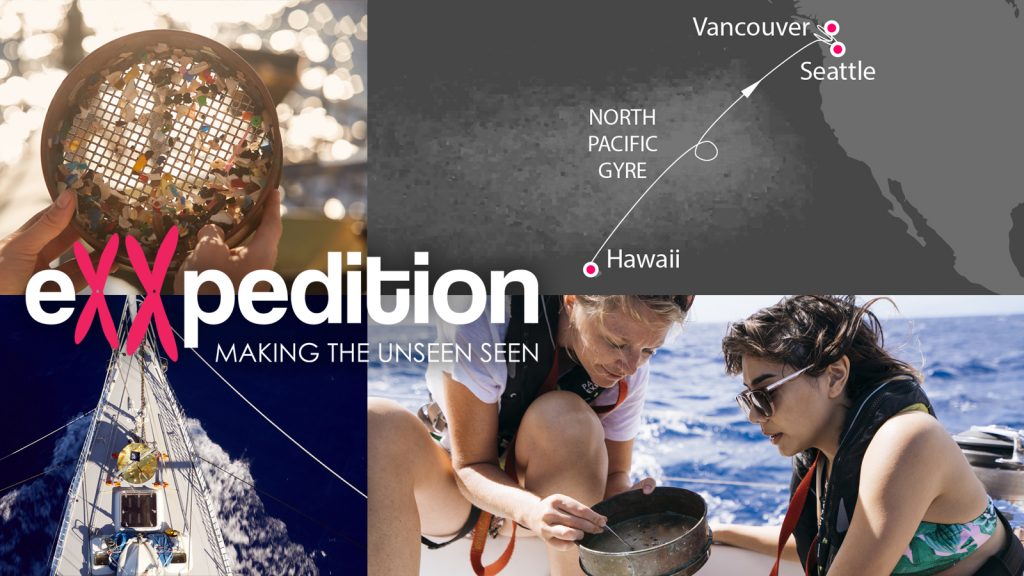
Spotlight: Global Marine Networks (GMN) and Iridium partner together to provide communications infrastructure for the ‘eXXpedition North Pacific’
If you have been following the Iridium blog, you may know that Iridium provided connectivity support for the eXXpedition – a series of all women voyages exploring and examining the impact and repercussions of ocean plastics and pollution. Behind this extraordinary cause is a team of talented women, and we had the pleasure of interviewing one of the organization’s founders, Emily Penn, who plays a critical role in each mission, and is a treasure trove of experience and information. Below we captured her story and perspective on their most recent voyage, the eXXpedition North Pacific, and wanted to share her insight with the Iridium community!
Iridium: What inspired you to start this amazing organization? Emily: My journey to tackle plastic pollution began 10 years ago, when I hitch-hiked around the world on a bio-fuelled boat to get to a new job in Australia. It was a job I didn’t end up taking. Instead, shocked by finding plastic in some of the most remote places on our planet, I chose to live on a group of pacific islands for six months to organise a community clean-up. I then traveled to California to learn more from some of the experts in the field of ocean plastic. Since then, my career has been dedicated to raising the profile of ocean plastic and has taken me all over the world facilitating science at sea, outreach and the implementation of solutions on land. In 2014, I launched eXXpedition – organising all-women sailing trips with a focus of plastic and toxics in the ocean. It was supposed to be just one voyage, but it was such an amazing experience with such great energy, we decided to do more. The last eXXpedition voyage was our 11th!
What has been the most interesting experience while out at sea? For me the worst thing is perhaps not what you expect. We do see some rafts of plastic and fishing line which easily entangle marine life, but for me it’s seeing the small pieces that overwhelms and astounds me every time. We take a fine net through the surface of the water and pull up hundreds of tiny fragments of plastic – it makes me release that the whole surface of our ocean is covered in a soup of plastic pieces.
How was the most recent voyage to the North Pacific Gyre? We had two amazing voyages as part of eXXpedition North Pacific with two fantastic crews. Each voyage had a different focus. Leg 1 went into the heart of the North Pacific Gyre to look at the levels of plastic and toxic pollution. It was worse than I’ve ever seen, but I was energised by the women on the boat. They saw the problem and they wanted to make changes and apply their skills to make a difference. Leg 2 was a complementing voyage, with a focus on how plastic pollution was impacting communities and remote coastlines in British Columbia. We visited beautiful remote islands and were moved by how plastic was washing up on uninhabited shores. Again, the women on board worked out how their own skills could start to tackle ocean plastic. This is why I organise these sails, so we can take changemakers to see the problem and then support them in having a positive impact.
What is the most difficult part of life out at sea? For a lot of the crew, the most difficult part is getting used to the motion of the boat, especially in some of the rougher weather we experience. Sea sickness makes it really tough for them, but it passes – it’s so often a case of sticking it out and making sure you do whatever you need to combat it.
What was the most surprising discovery made on this most recent trip? I was generally horrified at how much worse the plastic pollution was on this sail than any of the others I have done. When we were sailing through the North Pacific Gyre, the visible flow of plastic past the boat was constant. On the beach in Oahu, Hawaii, it was difficult to distinguish between plastic and shell. In the beautiful Broken Islands, British Columbia, we found thousands of tiny pieces of polystyrene all over the beach – we tried to pick up as much as possible, but it was an endless task.
Are there any rituals or superstitions you or any of the other crew members hold to during the expedition? There is a superstition that bananas on board a boat is bad luck. It turns out it’s quite true because they give off a gas that ripens other fruit and vegetables… so if you stow bananas down below, all your supplies go bad. If we do take bananas to sea, we hang them on deck!
During the most recent voyage, how did Iridium play a role? Iridium’s technology was invaluable during our North Pacific voyage because it allowed us to share our stories and experiences in real time from our vessel, called the Sea Dragon, even when we were 800 miles from land. It was exciting to have technology that allowed us to share video, as well as text and images, because it was important to us to be able to show the world exactly what it was like to be sailing through the area that’s known as the Great Pacific Garbage Patch.
Are there any “must-have” tools, gear and/or accessories you recommend for anyone about to embark on a voyage? Excellent communications are, of course, important for safety as well as communicating our messages. Other than that, some excellent waterproofs and warm layers – I’m almost always cold, especially on night watch!
What do you want the world to know about the current state of ocean plastics and Pollution? Most of the fragments of plastic in our ocean are smaller than your little fingernail, and the same size and plankton, making it nearly impossible to clean up. We need to push for upstream solutions from business and policy makers to stop the flow of plastic into the oceans.
How can people get involved with the eXXpedition? You can apply to sail with us! We are always looking for women from multidisciplinary backgrounds to join our crews. You don’t have to have any sailing experience, we just ask that you are passionate about making a positive impact on plastic pollution and applying your skills to the cause. You can apply for a 2019 voyage by visiting www.exxpedition.com/apply
Guest Blogger: Kyle Hurst, Director of Iridium Maritime Safety & Security Services
Every market uses a certain vocabulary. The maritime connectivity market is no different. Besides many regulatory acronyms such as Long-Range Identification and Tracking (LRIT), Ship Security Alert System (SSAS), Global Maritime Distress Safety System (GMDSS) – we all use technical abbreviations within our conversations such as High Throughput Satellite (HTS), Maximum Information Rate (MIR), Committed Information Rate (CIR) – the list is endless.
While we believe that we are communicating in the same terms, the actual definitions often depend upon the party that you convene with. For example, “broadband” as a term today will differ between an Internet provider and a maritime Satellite Network Operator (SNO). The same term ‘broadband’ will be perceived completely differently in 5 years from today.
The same rings true for the term “global”. Most SNOs claim to be global, but are they really? Is their “global” truly global? Does their global coverage cover only the main shipping trade routes? Iridium remains the only operator that doesn’t need a coverage map. If your ship can see the sky, the Iridium® satellites can see your ship.
Operators within a shipping management company are meticulous in their planning of a vessel’s trade. The trade routes are analysed using many different techniques, ensuring that they are optimised for fuel efficiency. However, the trade routes don’t take into account the vessel’s communications during the voyage. Would the commercial department be aware of holes in the global VSAT network, or if the VSAT antenna would be in blockage? A global VSAT network is not a single continuous beam that covers the earth. It consists of up to 40 separate beams stitched together, operated by several different SNOs. The VSAT modem cleverly blends these satellite signals, with a small loss of service as the VSAT antenna switches between the different beams. This methodology works well, but is still subject to blockages caused by (for example) the ship’s funnel or shore-based obstructions. It is imperative that a VSAT equipped vessel can switch over to an L-band based communications system that operates anywhere on Earth – even with obstructions.
The key difference between Iridium and other SNOs is our multi-satellite Low-Earth Orbit network. If a VSAT or geostationary satellite is in blockage, the antenna must search for a new signal. Assuming that another satellite is not available, the vessel’s communications will be restricted for a period of time – which can be excessive. This in turn can impact ship’s business, for example causing delays for voyage orders or Notice of Arrival and Departure message to port authorities.
Iridium’s CertusSM network is designed to operate in low signal conditions where other networks would struggle. Iridium Certus delivers the confidence that your fleet has connectivity across all five oceans.
Twenty years ago, Iridium announced to the world that its innovative satellite network was available for commercial use! Initially launched to service satellite phones and pagers, the Iridium network would allow anyone to communicate from anywhere.
Since November 1, 1998, the world has changed – and so has Iridium.
Iridium was first envisioned in the 1980s by a few bold thinkers who wanted to revolutionize communications. Bary Bertiger, Ray Leopold, and Kenneth Peterson began work on a space-based system that would allow people to connect to each other anywhere on the planet.
Ten years later, Iridium announced that the world’s first global handheld satellite phone and paging system was commercially available. Commercial service began on November 1, 1998 with the ceremonial first call by then-U.S. Vice President Al Gore to Gilbert Grosvenor, the great-grandson of Alexander Graham Bell and chairman of the National Geographic Society.
In the ten years it had taken to build, finance, and launch the Iridium network, however, cell phone usage had exploded – everyone had them, they worked well, and costs continued to fall. This put a lot of pressure on Iridium’s business case. Eventually the decision was made by Motorola to shut down the Iridium network.
Fortunately, just a few days before the Iridium constellation was scheduled to be deorbited, the company found a lifeline: the U.S. government.
A new, smaller team, led by Dan Colussy, took over and got to work on a new strategy starting with the U.S. Department of Defense and rapidly expanding to other markets. The company began identifying new ways to leverage the Iridium® network and saw great opportunities in a number of markets including aviation, maritime, land mobile, and governments, while also developing innovative machine-to-machine applications, now more commonly known as the Internet of Things (IoT).
Iridium also realized that to be successful, they needed help from companies that were experts in their respective fields with the technology, know-how, and relationships to capitalize on the Iridium network. These Partners recognized what Iridium could do for their customers. We supplied them with the devices and technology to access our network, and they began using Iridium in amazing ways to provide connectivity to users anywhere in the world.
The strategy worked! When Iridium formally re-opened for business and was signing up new subscribers in 2001, the network served 20,000 U.S. government users. Since then, Iridium has continued to grow to a network now serving over 1 million active subscribers in many markets and locations.
As our company grew and saw continued success, we knew we’d soon face a challenge: the original Block 1 satellites were growing old, having already outlived their five-to-seven year expected lifespans. In 2007, we announced our planned $3 billion investment in Iridium NEXT. This mission would be a complete replacement of the Iridium constellation and the largest technology refresh in history.
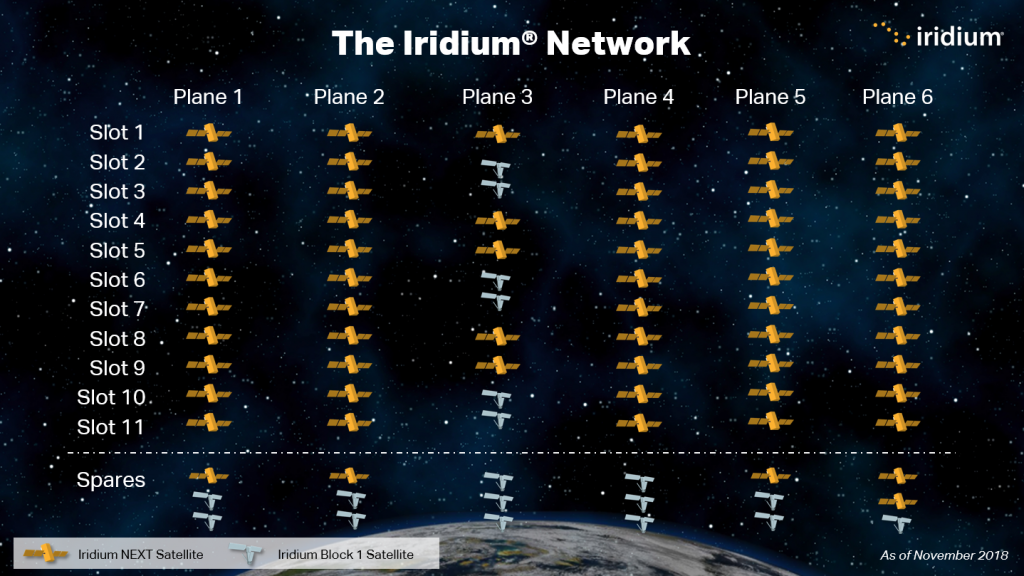
Now, with 65 Iridium NEXT satellites in orbit (60 active and 5 in-orbit spares), we are just one launch away from completing our network upgrade. As we near the end of the Iridium NEXT launch mission and say #flarewell to our Block 1 satellites, we are so excited about the new possibilities that the network will enable. Unlike the original network, which was designed with a focus on voice communications, the Iridium NEXT network will carry innovative hosted-payloads like the Aireon aircraft surveillance and tracking system, and enable connectivity for voice and data, allowing for stronger IoT capabilities, critical safety communications, and reliable, enterprise-grade broadband through Iridium CertusSM!
We hope you’ll join us in celebrating today’s milestone with Iridium trivia on Twitter, and follow along as our team shares their favorite memories at Iridium using #IridiumTurns20!
You are currently browsing the IFP blog archives for November, 2018.
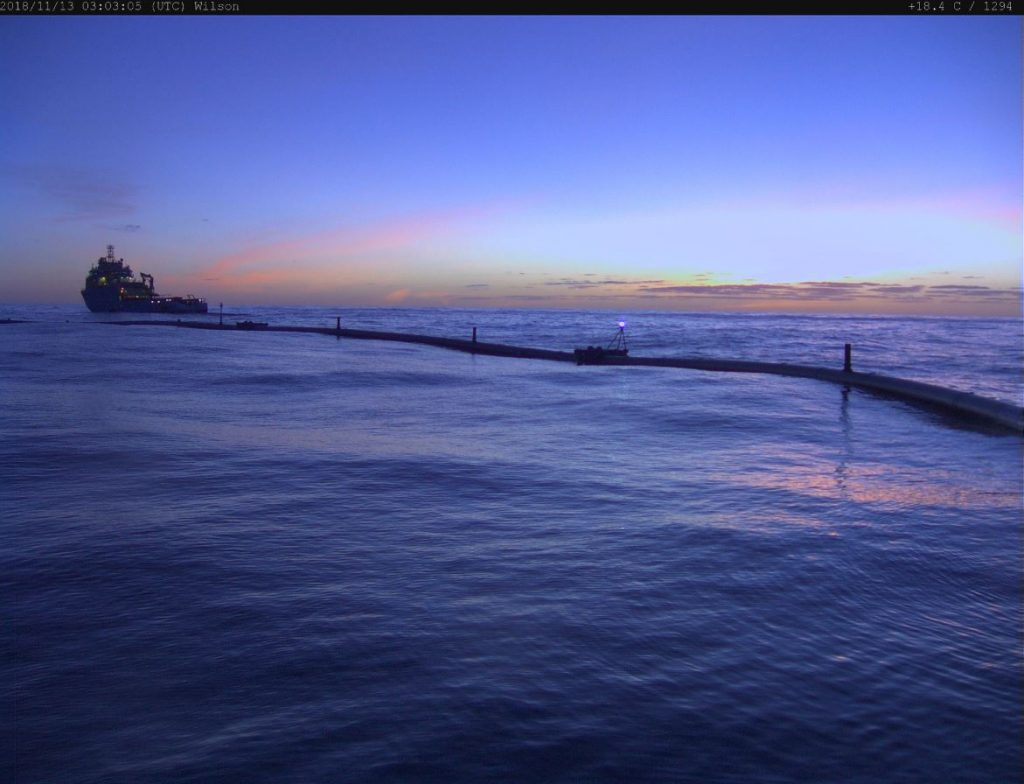 “Wilson” is equipped with two Iridium Pilot® terminals providing the Iridium OpenPort® broadband service, which allows the autonomous system to relay critical systems data back to the team in Rotterdam, including compartment flood detection, position and location information, pictures (like the one to the right), 360-degree video, and system performance information. As The Ocean Cleanup team scales up the project to 60 systems, Iridium and AST will continue to support the mission with terminals and service, and plan to begin providing Iridium CertusSM hardware and services once it becomes available.
 Guest Blogger: Will Kraus, Director, Maritime Business & Product Management

 Guest Blogger: Kyle Hurst, Director of Iridium Maritime Safety & Security Services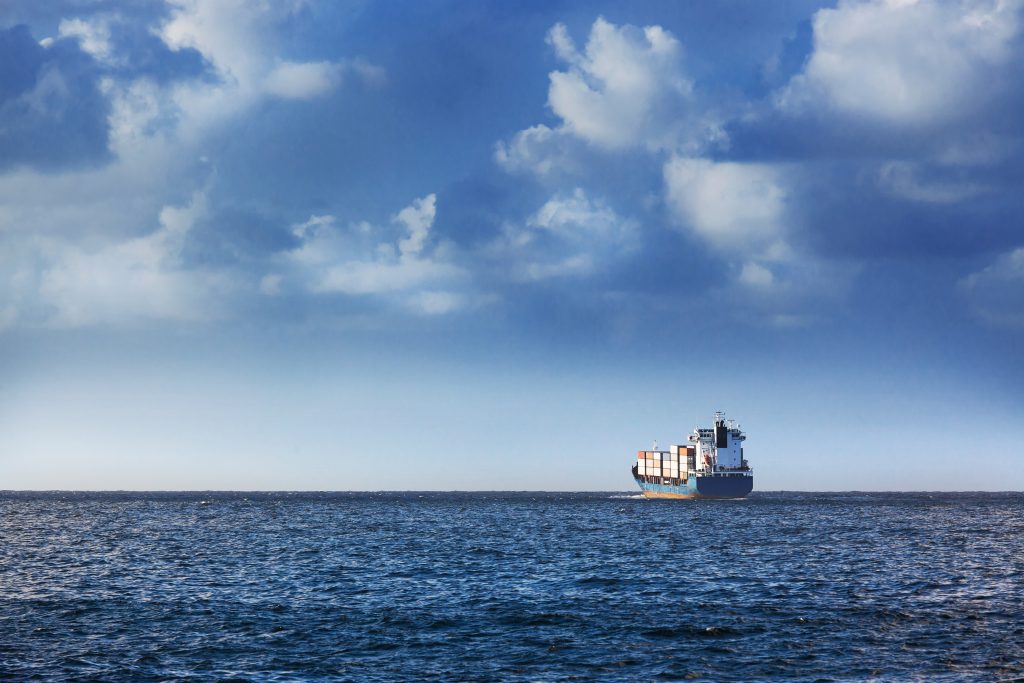
 Iridium was first envisioned in the 1980s by a few bold thinkers who wanted to revolutionize communications. Bary Bertiger, Ray Leopold, and Kenneth Peterson began work on a space-based system that would allow people to connect to each other anywhere on the planet.