Every September, the Federal Emergency Management Agency (FEMA) recognizes National Preparedness Month. The devastating hurricanes, earthquakes, wildfires, and other disasters that have affected millions across the world in the past few years serve as a crucial reminder about the importance of being prepared. An important part of planning for a disaster is making a disaster communications plan. Who would you communicate with during or after an emergency, and how would you get in touch with them?
Did You Know…
In 2005, Hurricane Katrina knocked out the terrestrial infrastructure in the coastal areas of Louisiana & Mississippi. The telephone lines of almost 3 million customers were knocked down & more than 25 million calls failed.[1]
In 2012, Hurricane Sandy knocked out 25% of the cell towers in the New York City area.[2]
In 2017, due to Hurricanes Irma and Maria, more than 95% of cell sites were out in Puerto Rico and 77% of cell sites were out in the Virgin Islands.[3]
Disaster Communications Preparations
As we enter into this year’s National Preparedness Month, take a few moments to review the basics of creating a communications plan for you and your loved ones during and after an emergency.
(1) Create an Emergency Contact List
Create a list of key contacts and phone numbers. Make sure to include:
Family members
Close friends
Insurance agency
Local government
Local hotels
Roadside assistance
Once you’ve completed your list, make sure to print it out in case you lose power before, during, or after an emergency. If a disaster is approaching, store this list in a plastic bag or other water-proof container along with other important documents
(2) Consider Satellite Communications
Reliable communications can make all the difference when traditional networks fail. A satellite phone or other satellite-enabled communications can work even when cell towers and other tradition systems are out, making it a good resource for your emergency kit.
At Iridium, we are proud to provide critical connectivity that operates reliably, effectively, and efficiently. Our satellites, which are in a low-earth orbit, are less susceptible to storms, earthquakes, floods, fires, and other disasters.
Tip! If you have a satellite phone, make sure to test it monthly.
How to Test Your Satellite Phone
Test your Iridium satellite phone monthly at 00-1-480-752-5105.
Keep your satellite phone charged and detach the battery before you put it in storage, so the battery doesn’t drain.
Place calls in an unobstructed outdoor area with a clear view of the sky.
Refer to the user guide for proper use and additional instructions.
Register Iridium satellite devices with an integrated SOS button (Iridium Extreme®, Iridium GO!®, Iridium Extreme® PTT) for emergency services at geosalliance.net.
Have a solar charger for charging in situations when the electrical grid is damaged. (Example: Solstar)
Have your Iridium Service Provider’s phone number for assistance.
Visit our YouTube channel for guided support through testing your Iridium satellite phone or device.
(3) Sign Up for Emergency Alerts
There are several ways to get emergency alerts:
Enable the federal alert / emergency notification system on your iPhone or Android device
Bookmark your city or county website for storm updates and local emergency instructions
(4) Plan to Contact Love Ones After an Event
Charge your communications devices before a disaster hits and limit usage during the storm to conserve your battery.
Use your satellite phone or enabled-device to communicate.
If using a traditional phone, try making calls during off-peak hours. If calls aren’t working, try sending text messages or emails.
Designate an out-of-town emergency contact to notify after a disaster. Ask your other loved ones to connect with him or her for updates on you.
Mark yourself as “Safe” on Facebook after an emergency.
Note: If you or a loved one has a serious, pre-existing health or mental health condition, you may also initiate an Emergency Information Request by calling your local American Red Cross Chapter or 1-800-RED-CROSS.
When reading about Iridium, you may have noticed that the phrase “hosted payload” has been popping up a bunch, especially when talking about our recent Iridium NEXT launches. But what exactly does that mean, and why is it so important?
First things first – what is a hosted payload? The Hosted Payload Alliance, a satellite industry alliance designed to bridge government and private industry, defines a hosted payload as: “A portion of a satellite, such as a sensor, instrument or a set of communications transponders that are owned by an organization or agency other than the primary satellite operator [Owner]. The hosted portion of the satellite operates independently of the main spacecraft, but shares the satellite’s power supply, transponders, and in some cases, ground systems.”
This model is becoming increasingly popular because of its benefits to both the satellite host and the hosted payload owner. The host (like Iridium), benefits from expanded capabilities by upsizing at a lower cost, savings from cost-sharing, and additional revenue opportunities, among many others. Meanwhile, hosted payload owners reap many benefits too. Namely, they can get into space quickly and less expensively since they do not have to develop an entire satellite system.
Here at Iridium, we have a long history with hosted payloads. Our original constellation, known as Block 1, hosted the Active Magnetosphere and Planetary Electrodynamics Response Experiment (AMPERE) program for years. Although Block 1 was not originally designed for hosting payloads, the constellation accommodated secondary missions using existing sensors on the satellites. The AMPERE sensors monitor space weather data in real time, enabling high-quality forecasting of space-based solar storms that can disrupt aviation and terrestrial telecom and satellite systems.
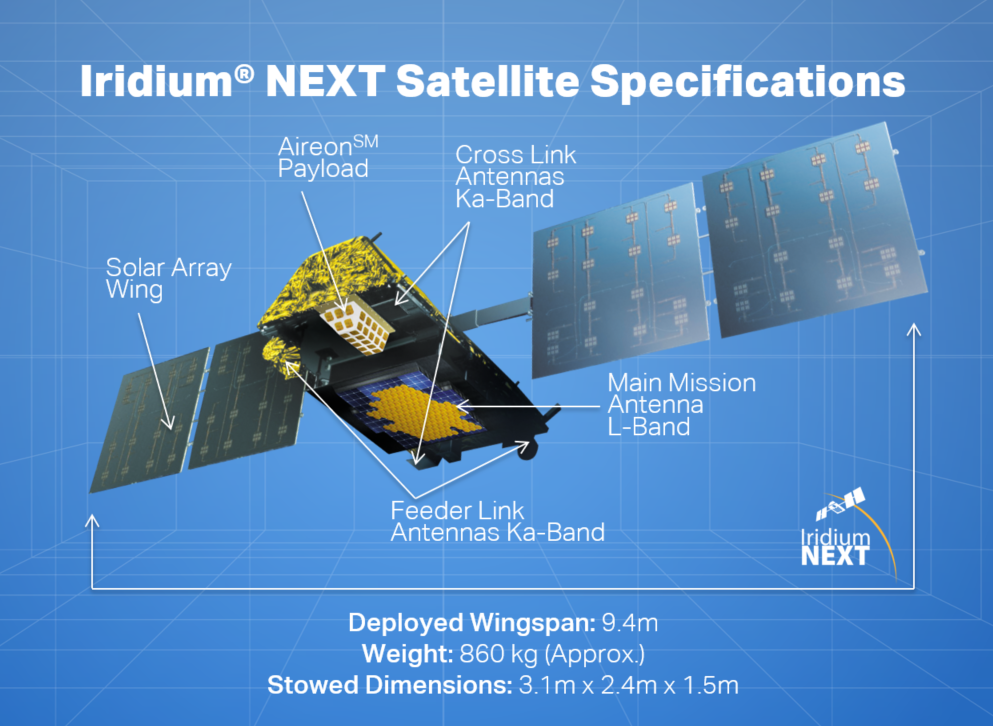
Seeing the benefits of a hosted payload partnership in Block 1, we specifically designed our new, second-generation satellites with a hosted payload opportunity in mind. The satellites currently being launched through our Iridium NEXT mission program were built to host an additional 50 kg payload from the start, a unique accommodation.
In 2012, we announced Aireon, a joint-venture that would provide air navigation service providers with the capability to track aircraft anywhere in the world in real time, including the only coverage over oceanic, polar and remote regions. This announcement also revealed that Aireon’s service would use space-qualified Automatic Dependent Surveillance-Broadcast (ADS-B) receivers built into each of our 81 second-generation satellites (66 in the operational constellation) to deliver its transformational capabilities.
With seven of eight Iridium NEXT launches complete, Aireon has already begun receiving data, delivering impressive results earlier this year.
Providing these services is essential to Iridium’s business functions. Through strategic partnerships, Iridium has been able to and will continue to provide unparalleled services to people and organizations across the world. The future is bright for Iridium, Aireon, and all other partners involved with these revolutionary hosted payloads!
Partner Spotlight: Global Marine Networks (GMN) and Iridium partner together to provide communications infrastructure for the ‘eXXpedition North Pacific’
If you have been following the Iridium blog, you know that Iridium and our partner GMN supported an all-female scientific voyage called the eXXpedition North Pacific, focused on gaining a better understanding of how pollution, specifically ocean plastics, is impacting the North Pacific Gyre. The crew recently wrapped up their journey aboard their vessel called the Sea Dragon. Being able to support such impactful initiatives like the eXXpedition North Pacific, is at the core of Iridium’s mission and is only possible through the help and collaboration of its partners.
“When the opportunity to team up with Iridium and support the eXXpedition North Pacific was presented to us, we couldn’t wait to get started,” said Kyle Tuczynski, head of products at GMN. “When big players in this industry collaborate, amazing things can happen. It’s been an exciting experience to be able to follow their progress during their journey, and we can’t wait to learn more about their findings.”
GMN is a longtime Iridium partner and played a critical role in keeping the Sea Dragon connected. GMN is a leader in advancing satellite data speeds and services, including satellite email, satellite phone internet and data optimization, offering a wide range of products to customers around the world. Over the years, GMN has helped expand Iridium’s reach through delivering a variety of devices and airtime packages using the Iridium® network across its global customer base. We are incredibly grateful for our strong partnership with GMN and look forward to future collaborations and projects!
To celebrate reaching one million active subscribers, Iridium will be featuring the success stories of our customers in the range of markets we serve: land, maritime, aviation, IoT, and government. Experience their stories and see the growing impact Iridium has had on a personal, organizational, and global level.
Using PTT (Push-to-Talk) capabilities on the Iridium® network, customers can communicate efficiently over an encrypted connection without being inhibited by distance. Arion, an Iridium partner based in Seoul, Korea, serves government/military, aviation, maritime, and enterprise organizations. Both Arion and its customers consider safety a top priority, and a key part of their relationship is their shared trust in the reliability of the Iridium network. Another Iridium partner, Kaigai Corporation, focuses on the “life-cycle support” of aircraft electronics and avionics devices. Kaigai relies heavily on the secure communications provided by Iridium to offer the best safety systems possible.
Hiroyuki Yamakawa, director of Kaigai, values Iridium because it is “the best option during and after a disaster.” He notes that when the 9.1-magnitude earthquake off the coast of Japan in 2011 triggered massive tsunami waves, cellular and landline phone operations were severely inhibited. Because of the widespread damage to infrastructure, Yamakawa notes, “Japanese communications systems were not working at the time, but devices powered by the Iridium network did.” In disasters ranging from hurricanes to earthquakes and tsunamis, PTT can be a life-saving tool for beyond-line-of-sight communications.
Watch our partners explain how Iridium Push-to-Talk has been a “game changer” during natural disasters in the video below, and read more about push-to-talk technology here.
Do you have a story about how Iridium technology has improved your safety, your quality of life, or your business operations? Select “Have a Story” here and share with us how Iridium keeps you connected. You may be featured in our “1 Million Subscribers Connected” campaign.
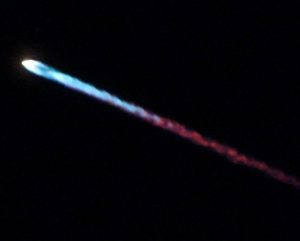
As we say #flarewell to our Block 1 satellites and make way to the future of Iridium® NEXT, Iridium Flare fan Samuele Pinna is seeking to catch a photo of an Iridium Flare from each of our original satellites. He created the Catch the Iridium, a fan site for Flare enthusiasts around the world to help create a photo collection before the Flares are gone forever. We caught up with Pinna to learn more about his Catch the Iridium project.
Q: What inspired you to create this project?
A: Since the first time I learned Iridium was replacing its existing constellation by sending 75 Iridium NEXT satellites into space, I asked myself if the new satellites would be able to generate the famous Flares which made the Block 1 constellation famous among all the amateur astronomers of the world. Once I realized that unfortunately it would not be so, I thought it would be nice to make a kind of “family photobook” with at least one picture of a Flare from each of the Block 1 satellites. I was aware that it would be impossible to reach the goal alone. That’s why I created the Catch the Iridium project with the hope of involving as many amateur astronomers as possible.
Q: How and when did you learn about Iridium Flares?
A: Despite being a phenomenon known for over 20 years, I personally observed my first Flare only a few years ago. At that time my attention was directed to the International Space Station’s (ISS) transits and in order to know in advance when it would be visible as it passed over my town, I started to use a smartphone app, and that was where I discovered “Iridium Flares”. So, it was there that I started to inform myself of Iridium Flares’ nature and the Iridium company history.
Q: When is the best time of the day to “catch” a photo of an Iridium Flare?
A: There are three important parameters that give the answer to this question: sun altitude, satellite altitude, and Iridium Flare magnitude. To take a Flare’s picture, we need to use the camera “bulb” function, shooting at least for 10-15 seconds. To avoid a sensor saturation, it is mandatory to have a dark sky: the sun must be gone from 30-45 minutes at least. Moreover, a satellite’s altitude should be at least 20-25° over the horizon to avoid light pollution and bad effects. Flare magnitude, of course, affects the quality of the shot: the greater it will be, the better the picture will be. So, the three questions to ask are: Is the sky dark enough? Is the foreseen satellite’s Flare altitude high enough? Is the Flare’s peak magnitude great enough? If you’ve got three yeses, you have the best time to catch the Iridium Flare.
Q: What are some of your best tips for new Iridium Flare “catchers”?
A: Catching an Iridium Flare may seem complex, but in practice it is a doable challenge for everyone. We created a short how-to guide on our site for all people which want to try to photograph a Flare. Out of the many suggestions that could be given, however, I would recommend the use of a camera tripod and a remote controller. I also recommend starting to shoot with a 30-50 mm lens and, only after doing a little practice, switch to a greater zoom.
Q: How many Iridium Flares have been “caught” since you started the project?
A: More than expected for sure! I was hoping for a positive answer from the community to this call to action, but I could not imagine that after barely a month from its official launch would have reached over 110 photos, of 49 Iridium Flares out of 95, coming from many different countries such as Italy, Austria, France, UK, USA, Canada, Japan, and more.
Q: Do you have a favorite Iridium Flare photo? If so, which one?
A: I believe that all the pictures received are beautiful because they concentrate a moment of amazement experienced by the authors in their realization. Among the many beautiful pictures received, I would certainly mention the one made by John Pahl at the foot of Big Ben in London, but I repeat, all those received deserve a mention and their space that I hope the gallery of Catch the Iridium can offer.
Q: Is there anything else you would like for people to know about this project?
A: Of course! Take advantage of these last months to enjoy the show of Iridium Flares! I really hope that this project will allow even the less “insiders” to know about a beautiful phenomenon that has accompanied the evenings of many amateur astronomers in the world over the past 20 years. Stephen Hawking said: “Remember to look up at the stars and not down at your feet”. Well, I like to think that he meant to invite everyone to look up at the sky, even simply to observe an Iridium Flare. #flarewell!
Check out CatchTheIridium.com to view the Iridium Flare gallery or submit your own photos, and make sure to follow the project on social media.
Internships have become a staple of career preparation for young professionals wishing to gain meaningful experience prior to entering the workforce. The Department of Labor defines an internship as “a formal program providing a practical learning experience for beginners in an occupation or profession that lasts a limited amount of time.”
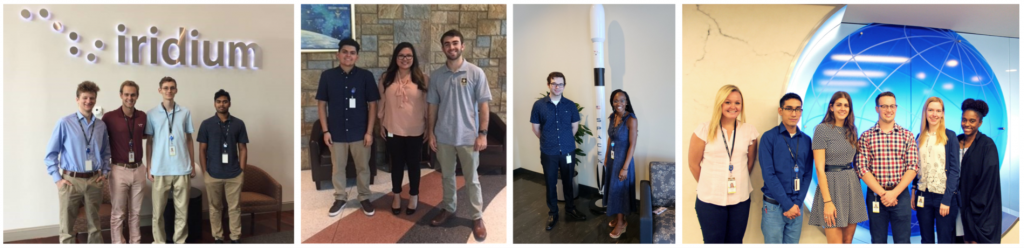
This summer, we had 17 interns across the company, working in the engineering, marketing, human resources, IT, legal, and finance departments. These students were located in several of our facilities across the United States – Iridium Headquarters in McLean, Virginia; the Satellite Network Operations Center (SNOC) in Leesburg, Virginia; the Primary Earth Gateway Station in Tempe, Arizona; and the Rimrock corporate facility in Tempe, Arizona.
As the summer of 2018 went on, Iridium interns chipped away at various projects in their respective groups. The work of an Iridium intern truly varies by department!
For example, Aaron O’Connell, a rising sophomore at George Mason University, worked in the engineering department within the Space Systems team. He described his experience:
I’ve gotten to work on a lot of different projects with several different groups. Some of the most fun work has been the coding that I have done. One of my favorite languages is HTML, and I was able to create a couple of webpages for two of the groups I have worked with so far.
Aaron worked alongside three other engineering interns this summer, who worked on projects like designing displays for the Kband team, testing Iridium® transceivers and antennas, commanding satellites from mission control, writing PassPlan templates, verifying satellite configurations, and supporting the Iridium NEXT mission. These interns worked at different Iridium facilities across the country, but together helped keep our satellites and network operational.
Meanwhile, Alex Denson, a graduate student at the University of Oklahoma, was a Human Resources Intern in Arizona. She said:
I applied to be an intern at Iridium because the job description highlighted the various parts of HR that I am interested in, such as recruiting, onboarding and employment laws. During my interview, the HR team talked about how wonderful working for Iridium is and how much I will learn throughout my internship at Iridium! Some of my daily functions are to manage the open jobs through an applicant tracking system (ATS) called iCIMS, source for great candidates, learn different onboarding process and keep track of and organize employee files. For these duties I collaborate with the whole HR team in the Arizona and Virginia offices.
Alex also worked alongside another HR intern based at HQ, Courtney Griffiths, to implement a new employee recognition software. The goal of the software is to have Iridium co-workers recognize each other for jobs well done, with the possibility of tangible rewards upon gaining points.
Back in HQ, the marketing team interns supported a wide variety of tasks across all areas of Iridium. With projects ranging from web development and graphic design, to partner case studies and content creation, we had our hands full!
Maeve Hickey, a University of Virginia student, is an all-star writer. She created content for online channels and partner resources. She says:
It’s been rewarding to see the case studies I wrote go into layout and then be published on the Iridium website. It’s important to understand something before trying to explain it to readers, so I am constantly learning more about our different lines of business. And, this summer in particular, we had the privilege of being here while the whole team geared up for Launch 7. At headquarters, we gathered in the kitchen around 7am to watch the SpaceX livestream (and timed the Launch 7 Spotify Playlist to line up perfectly!) in a room full of people who had directly worked towards making this possible. Not a lot of internships offer an experience like that!
Vanessa Johnson, a student-athlete at Xavier University, worked on web design and development, while integrating data analytics techniques into Iridium’s day-to-day processes.
I am so grateful for this opportunity I have been given. The ability for me to collaborate with the brilliant minds in this company has pushed my abilities. As a student athlete, I have been challenged and rewarded for overcoming obstacles. This internship has been one of my toughest challenges, but nothing is more rewarding than to see my designs published and people liking my design or concepts.”
And I, Kylen Bailey, wrote blog posts (like this one!), created graphics, and supported disaster response planning efforts this summer. It was a thrilling opportunity, giving me many immersive and challenging experiences.
As you can see, every department at Iridium has a unique set of goals, projects, and challenges – making for an exciting opportunity for us Iridium interns. Being with Iridium during the Iridium NEXT launches was especially exhilarating, and we as interns couldn’t be more grateful to have had the opportunity to be here at such an incredible time!
Cheers to Iridium’s bright future and all the students headed back to school!
Are you interested in being a part of the Iridium team? Learn more about internship and job opportunities on the Iridium Careers page or view current openings here.
To celebrate reaching one million active subscribers, Iridium will be featuring the success stories of our customers in the range of markets we serve: land, maritime, aviation, IoT, and government. Experience their stories and see the growing impact Iridium has had on a personal, organizational, and global level.
When it comes to global connectivity, Iridium means business: the Iridium® network covers the entire planet’s surface. For Appareo’s agricultural customers, this makes a big difference because equipment operating in fields out of range of cell towers will still have a strong connection. Appareo focuses on using big data to offer remote support and control, machine automation, and intuitive sensor technology to its customers, who operate in a range of industries from agriculture to construction to custom engineering. For more than five years, Iridium and Appareo have worked together as partners to create innovative solutions for telemetry and remote fleet management.
Jeff Johnson, President, Appareo IoT, values Appareo’s partnership with Iridium because a network with global connectivity “lets customers expand the way that they can even imagine their products.” Many of Appareo’s customers need connections in extremely remote areas, and the strength of the Iridium network helps Appareo to keep innovating to suit their needs. With the agricultural equipment manufacturer AGCO, for example, Appareo introduced a way to turn telemetric equipment setup from a two-day process to one that took just fifteen minutes! Innovations like this one are reducing time to market and helping growers plow, plant, and harvest more efficiently, cutting down on costs.
Do you have a story about how Iridium technology has improved your safety, your quality of life, or your business operations? Select “Have a Story” here and share with us how Iridium keeps you connected. You may be featured in our “1 Million Subscribers Connected” campaign.
What is it that draws people to the outdoors? Is it the sun…the sand…the fresh air…? Maybe it’s the sound of your feet on the pavement. Or the sound of crunching ice on your expedition? How about the howl of the wind on a mountain top, or the spray of water from the rapids? For me, getting out there is to simply be in tune with myself and my environment. But it is also about being my best self, achieving my goals, and checking items off my bucket list. Then, there are the few who go to different places around the world, tackling challenges that most wouldn’t even dare to attempt.
When we’re outdoors, we rarely think of the fact that we are an integral part of the Internet of Things – or more simply put, IoT.
Let’s step back for a moment. What is IoT, really? There is so much buzz around it, especially in industries that operate connected machine ecosystems (think: industrial automation, control, and monitoring). The Internet of Things (sometimes also called the “Network of Things”) refer to connected devices, sensors, and associated data collection, connected through a network. IoT allows machines to “talk” to one another, gives us humans the ability to see where something is, how it’s operating, and even send commands to turn it on or off. Companies often use this technology to track, control, and monitor things like assets, fleets, automated agriculture, buoys, construction, global marine and air fleets, and more.
In our connected world, individuals use IoT too – think about the devices we use, wear, or carry with us…and the data that we collect from it. For example, I like to run marathons all over the world. The data – like my heart rate, speed, distance run, calories burned, etc. – that I collect during my training from wearable sensors are invaluable. These metrics help drive my success because I can see how I performed and work to improve next time. If I don’t use the data, then all the devices I own to help me track my runs are really just (pricey) paperweights. That also means a personal tracker and communication device is useless unless I can see where I am – or if I can share my location with others.
During one of my recent visits to our office in Arizona, I went on a run on a trail in the mountains outside the city. While on my run, I got injured. I could see the city lights from afar. I could tell civilization was all around me. But I had no way of letting anyone know that I was hurt or in trouble. Fortunately, I wasn’t alone; I had a running friend with me. The descent back from the trail was painful, but I learned a good lesson: personal tracking devices provide peace of mind to both the person carrying it and their loved ones. Most personal tracking devices are lightweight, water/shock resistant, and can be worn on the body or clipped onto your bag. Personal IoT devices that use the Iridium® network, like the Garmin inReach Mini, connect anywhere in the world through our satellite network, providing position tracking, weather information, and the ability to send text messages or trigger an interactive SOS to the 24/7 search and rescue monitoring center.
When you’re out there, if you’re lost, suffering from heat exhaustion, injured, or in trouble, there is peace of mind knowing that the Internet of Things is out there!
Now, let’s go explore!
To learn more about IoT, and how Iridium services and our partner products fit in, check out this short video below:
As part of our commitment to empowering the future generation of the space industry, we were thrilled to share the experience of last week’s Iridium® NEXT Launch 7 with 85 eighth-grade girls from Tech Trek summer camp in Santa Barbara, California.
Tech Trek is a STEM-focused camp for girls interested in becoming scientists, engineers, mathematicians, and computer specialists. In the days leading up to launch, the Tech Trekkers learned about the space industry, Iridium, and the science behind it, using educational materials and fun facts created by Iridium and presented by their teacher Charlie McGillis, of the Commercial Integration Cell at Joint Space Operations Center (JSpOC). Then, the group watched the launch together from Santa Barbara (at 4:30 a.m.!), and each girl got her very own commemorative launch patch to remember the occasion! Some campers shared their experiences below:
“Hi! I am currently attending the Tech Trek camp in Santa Barbara and had the opportunity to see the Iridium-7 launch on July 25, 2018. It was amazing to have been a witness of that. I had never experienced a launch, and when I heard that we had a chance to see one, even if it was at 4:30 a.m., I couldn’t pass it up. I felt so awe-struck and I finally realized just how much a group of people, a team, can do when they put their heads together and try. Thank you for doing everything you do and thank you for the patch.”
“The launch on Wednesday was really cool to watch. I would wake up at 4:30 every morning to watch that. It was amazing to watch the different stages occur exactly how [our teacher] Charlie told us they would. My favorite part was when the two parts separated, and we saw the rocket fall back to Earth. Thank you for such an amazing experience.”
“When we went outside to watch the rocket launch, I was anxious, as I’ve never seen one before. As I looked up into the sky, I saw the most fascinating scene I could ever encounter. The rocket was shooting through the clouds above with flames shooting out the other end. To say this was amazing was an understatement. It was phenomenal. This was absolutely one of the best experiences I’ve ever had.”
“It was 4:10 a.m. All of sudden, a loud knocking repeatedly hits my door. I quickly jumped up, realizing it was time for the launch! I throw on some sweats, a jacket, and sandals. We all ran into the hall, watching another launch on a tablet. Seeing that, made me more excited than I already was for the Iridium launch. We all ran to the grass, and about 5 minutes later, something like an orange light appeared in the sky. The whole crowd cheers with amazement! We see it start to change colors, and it disappears and reappears. Then, with a cold brisk, we all go back to bed, thinking of our amazing experience.”
“On Wednesday, the 25, some other campers and I woke up at 4:30 a.m. to see the rocket launch from Vandenberg. Even though it was early, I’m very glad I went to see it. It was a new experience to me, having never watched a rocket launch before. Thankfully, [from where we were], the sky was clear, so we had an excellent view. We watched the rocket take off and saw part of it return. I loved watching the launch and was mesmerized by it all. Also, thank you so much for sending the patches! I will now have something to remind me of the launch and Tech Trek. Overall, I had a great time at the launch!”
“My favorite thing that I did at Tech Trek was see the Iridium launch from Vandenberg. I have never seen a rocket launch before, so it was really cool that I got to witness it for the first time at Tech Trek. I watch a TV show called The Flash on the CW network and there is this really cool thing called Speed Force, and the launch really looked a lot like that. I felt like it was the Fourth of July again because when the rocket was in the air it looked like fireworks. Thank you so much for the patch; it is amazing, and I will definitely treasure that patch for a long, long time.”
The 10 Iridium NEXT satellites launched as part of this mission were delivered to orbital plane number five. The Iridium network is comprised of six polar orbiting planes, each containing 11 crosslinked satellites for a total of 66 in the operational constellation. In total, 81 satellites are being built, with 75 planned for launch through the Iridium NEXT mission program. Nine of the satellites launched will serve as on-orbit spares, and the remaining six will be ground spares. For more information about Iridium NEXT, please visit www.IridiumNEXT.com.
You are currently browsing the IFP blog archives for August, 2018.
 Every September, the Federal Emergency Management Agency (FEMA) recognizes National Preparedness Month. The devastating hurricanes, earthquakes, wildfires, and other disasters that have affected millions across the world in the past few years serve as a crucial reminder about the importance of being prepared. An important part of planning for a disaster is making a disaster communications plan. Who would you communicate with during or after an emergency, and how would you get in touch with them?
 In 2012, we
 Q: What inspired you to create this project?



 Guest Blogger: Jaco Botes, Senior Manager Iridium IoT Product Management