Over 20 years ago, Iridium launched a constellation of 66 satellites into space, paving the way for the future of satellite communications. Since their launch, the “Block 1” satellites created the largest global commercial satellite constellation, delivering reliable and critical communications to people, businesses and governments worldwide. From Earth, unexpected reminders of the constellation’s presence appeared – Iridium Flares, a streak of light in the sky caused by sunlight reflecting off the main mission antenna of an Iridium® satellite. These Flares, which can be seen anywhere in the world, have been likened to shooting stars.
Since the original launch of these Block 1 satellites, the world has changed – and so has Iridium. After living well beyond their initial lifespans thanks to the engineers at Iridium, the Block 1 satellites are being retired to make way for the future of Iridium. We are in the process of conducting the largest constellation replacement program in history, known as Iridium NEXT, all without any disruption in service. Our Iridium NEXT satellites will enable Iridium CertusSM, our new and advanced multi-service platform built to redefine the capabilities of mobile satellite communications.
We’re sad to say that as our original Block 1 satellites are deorbited, they’ll be taking their Iridium Flares with them. In light of that, we are excited to launch our #flarewell tribute page today. This page is dedicated to you – our Iridium supporters and Flare enthusiasts around the world!
On the #flarewell page, you’ll find Flare photos and stories from astrophotographers around the world, news clippings about Iridium Flares, details on how to catch a Flare, how we are working to responsibly deorbit Block 1 satellites and sustain space for future generations, a feed of the most recent #flarewell pictures being share on social media, and more!
We hope you’ll join us in saying #flarewell to our Block 1 satellites and help us welcome the future of Iridium NEXT! Check out our new web page at www.Iridium.com/flarewell, and make sure to tag #flarewell in your Flare photos and stories on social media:
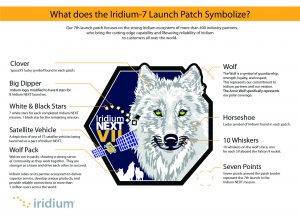
Each component of this Iridium® NEXT Launch 7 patch has its own special and unique meaning. Representative of guardianship, strength, loyalty and respect, the wolf is symbolic of Iridium’s vast partner ecosystem. Traveling in packs, wolves exude a sense of community and collaboration, embodying Iridium’s core value of teamwork. Without its own “wolf pack” of more than 400 industry partners, Iridium would not be the company that it is today, delivering a superior service to more than 1 million users across the globe.
Take a look below to get a peek behind the curtain on every detail!
Interested in learning more about each patch from the previous six launches? Click here to access past patch descriptions.
To check out Iridium NEXT launch gear, please visit our online store.
Iridium Communications, in partnership with SpaceX, is prepared to launch 10 Iridium® NEXT satellites tomorrow, July 25. SpaceX will launch this seventh set of new satellites on its Falcon 9 rocket to low Earth orbit. The payload and the rocket have been transported to the launch pad, and the rocket is vertical for launch. The rocket has an instantaneous launch window scheduled for 4:39:30 am PDT (11:39:30 UTC). Once deployed, there will be a total of 65 Iridium NEXT satellites in space.
Iridium NEXT is the company’s $3 billion, next-generation, mobile, global satellite network scheduled for completion in 2018. These new satellites are replacing the company’s existing global constellation in one of the largest technology upgrades ever completed in space. It represents the evolution of critical communications infrastructure that governments and organizations worldwide rely upon to drive business, enable connectivity, empower disaster relief efforts and more. Iridium NEXT will enable and introduce new services like the Company’s next-generation broadband service, Iridium CertusSM.
Want to watch the launch live? Tune into the SpaceX webcast at www.spacex.com/webcast for a live feed of Iridium-7 starting 15 minutes prior to liftoff! And don’t forget to follow along with our Ultimate Launch Soundtrack on Spotify!
About Iridium Communications Inc.
Iridium is the only mobile voice and data satellite communications network that spans the entire globe. Iridium enables connections between people, organizations and assets to and from anywhere, in real time. Together with its ecosystem of partner companies, Iridium delivers an innovative and rich portfolio of reliable solutions for markets that require truly global communications. The company has a major development program underway for its next-generation network — Iridium NEXT. Iridium Communications Inc. is headquartered in McLean, Va., U.S.A., and its common stock trades on the NASDAQ Global Select Market under the ticker symbol IRDM. For more information about Iridium products, services and partner solutions, visit www.iridium.com.
Iridium Creates the Ultimate Launch Soundtrack on Spotify
Iridium NEXT is one of the most ambitious projects ever attempted in space. Technologically, the original Iridium constellation was one of, if not the, most complex networks ever created, now only to be surpassed by an upgraded version. With six of eight launches already completed as part of the Iridium NEXT deployment campaign and 55 new satellites in orbit, the Iridium team is looking to make sure we commemorate our final two planned launches in fun and unique ways.
Introducing the Iridium NEXT launch soundtrack!
For both the Iridium-7 and Iridium-8 launches (and maybe even some other fun stuff coming in the future), Iridium audiophiles will be curating themed playlists featuring songs designed to either reflect what viewers of the SpaceX webcast are watching or are in some way related to the Iridium story (including metaphorically).
One of our goals for this playlist is to ensure it’s a fairly-diverse array of music and has something for all listeners, but hopefully everyone will enjoy what each song brings throughout the broadcast!
So how does it work?
Iridium has created a launch soundtrack on Spotify. Here’s a step-by-step guide to help you join the fun.
Step 1: Search for the Iridium Communications Inc. account on Spotify, and make sure it’s the one that’s verified! Or you can click this link to directly access the playlist.
Step 2: Select the Iridium-7 Launch Soundtrack from the playlists section. You should now see all the songs in order.
Step 3: Next, open your web browser and visit http://www.spacex.com/webcast about 15-20 minutes before launch, so at around 4:20 AM PDT, which is 7:20 AM EDT (11:20 UTC). Launch is scheduled for 4:39:30 AM PDT (11:39:30 UTC).
Step 4: Once the SpaceX webcast begins, find the timer in the top right corner of the screen that shows a countdown to launch.
Step 5: When the countdown timer reaches 10 minutes and 30 seconds, press play on the first song of the playlist, and then just let it play. (We recommend keeping the volume low enough to hear the host clearly!)
Step 5A: If you joined the show late, or had to pause the playlist, have no fear. We will be live tweeting at what point on the timer (that same one in the top right corner), each new song will start, giving you an opportunity to get back in the game! For example, you may see a tweet like this:
“To join in with the playlist crowd, press play on Iridium-7 Launch Soundtrack Song – [SONG NAME] at T+9 minutes 47 seconds @Spotify #Iridium7”
After that, there’s nothing left to do but watch, listen and enjoy. And yes, everything that happens; the timing, the words, the irony — has all been specifically designed to create a unique viewing and listening experience. (Hopefully it works out as planned!).
Warning: This will only work seamlessly for Spotify Premium users.
But, we’ve got you covered – The playlist is included at the bottom of this post so everyone without Spotify Premium can build the list themselves. We just ask that you pay close attention to song lengths and versions, to make sure things line up as accurately as possible!
How we picked the songs:
Deciding on what songs to pick was NOT easy. As a result, we created a list of criteria that each song had to meet. They include:
Avoid profanity, explicit lyrics or graphic language
Avoid clichés (i.e., Rocketman – sorry)
Allow one exception to “avoid clichés” rule
Relate to either what is being viewed on screen, the “Iridium story” or our business
Matt picked it (our CEO, aka @Iridiumboss – although we’re not sure yet if he realizes we’re really including that song)
Represents a broad/diverse array of music/artists/bands
Serves as an ode to a relevant person, place or event
Represents some level of irony if they don’t fit in the other categories
We hope you’re as excited about this as we are, and that you will get a few laughs, do some head bopping along to the tunes and if you feel like, dance a little like nobody’s watching.
Also, for the Iridium-8 Launch Playlist (our final planned launch), we’re going to open song suggestions up to anyone and everyone, so if you have that eureka moment and think of a perfect song, let us know in the comments section of the blog or on social media.
Two years ago, my high school started a Capstone program that allows seniors to explore different fields of work by participating in a two-week internship or volunteer program. Because I will be starting at the School of Engineering and Applied Science at the University of Virginia this fall, I wanted to experience the daily activities and responsibilities of working engineers when it came time to choose a place for my Capstone. I was thrilled to have the opportunity to get in touch with Robert Sholl, the Space Systems Payload Group Manager at Iridium. Being able to interact with engineers working to launch and operate satellites was definitely something I wanted to pursue!
In late May, I arrived for the first time at the Iridium Satellite Network Operations Center (SNOC) in Leesburg, Virginia, and immediately became excited when I got my own badge! I sat in with the college summer interns for their orientation. I was amazed to learn the scope of the work that Iridium does, using the complex network of satellites for telephony, Short Burst Data® transfer, and much more. I focused on absorbing as much information as possible, like the unique ability of Iridium® satellites to communicate with surrounding vehicles through cross links, or that the Iridium network is the only one to really have coverage over the whole globe.
My second day at Iridium, I was able to observe from the control room while five new Iridium NEXT vehicles were launched from Vandenberg Air Force Base in California. Alongside Iridium engineers, I witnessed the vehicles make first contact with the ground using their secondary links. I even got to use a data retrieval program to collect temperatures and signal strength from the launched vehicles.
During my two weeks at Iridium, I rotated between different teams to get a complete view at what is needed to upkeep a network of 66 operational satellites. I sat with members of the L-Band and K-Band groups, the systems team, and the platform team. One of my favorite things I had the chance to do was make a pass plan with the K-Band team for a configuration change on two of the vehicles to update the calculated distance between them. Updating this distance ensured that when one vehicle turned on its cross link the other would then turn on its crosslink at the appropriate time to receive the signal. After helping design the plan, I was able to actually send the commands to the satellites from the control room.
I also learned about the computing systems on the satellites, the thermal systems on board, what happens if a vehicle goes into safe mode, the orbit of the vehicles, and so much more! My greatest takeaway from my Capstone was seeing how all the different systems interact with one another to reach an end goal. It made me realize just how important communication within a team is, especially when dealing with satellites costing millions of dollars. The environment of the office was one of collaboration, which made it easy for me to ask questions and discuss topics with people in a range of positions. With this experience under my belt, I’m excited to start my studies at UVA and apply the skills that I witnessed firsthand at Iridium.
Marsat, an Iridium® partner based in Moscow, works to provide communications solutions over land, air, and sea throughout even the most remote regions of Russia. Run by Russia’s Federal Agency of Maritime and River Transport, Marsat serves both private companies and government operations. Iridium is the only company providing total satellite coverage over the Arctic Circle, an area Russia wants to explore because of its rich natural resources. Many of Marsat’s customers seek out Iridium technology because Iridium’s truly global connectivity makes it the best service for their needs.
Marsat mainly provides maritime solutions, but it also works with Russian railroad systems and other transportation markets. In a region as remote as Siberia, only Iridium offers the connectivity needed for monitoring trains and ships to improve their safety. Iridium’s work with partners like Marsat will likely grow now that the International Maritime Organization has officially recognized Iridium to provide GMDSS services, starting in 2020. Marsat CEO Andrey Kuropyatnikov said that this approval “is exactly what is needed and will give us additional advantages in using satellite communications services in the North, where currently, a GMDSS coverage gap exists.”
Iridium empowers partners like Marsat to offer global, more feature-rich and cost-effective options to their customers. Together with Iridium, Marsat is innovating to make transit smarter and safer.
Watch Kuropyatnikov explain the importance of Iridium technology to government and private customers in Russia.
Do you have a story about how Iridium technology has improved your safety, your quality of life, or your business operations? Select “Have a Story” here and share with us how Iridium keeps you connected. You may be featured in our “1 Million Subscribers Connected” campaign.
Project Spotlight:Iridium® and Global Marine Networks (GMN) collaborate to provide the eXXpedition North Pacific with reliable satellite connectivity.
On June 25th, a vessel named the Sea Dragon, began the first leg of a challenging 3,000 nautical mile voyage sailing from Hawaii to Vancouver, to evaluate the collection of ocean plastics and pollution in the North Pacific Gyre, also known as the Great Pacific Garbage Patch. Participating in the eXXpedition North Pacific is a team of 24 women. For each of the two legs, 14 crew members will be on board at all times, with four remaining on board for both legs. This crew specializes in the science, technology, engineering and math (STEM) fields ranging from environmentalists and marine scientists, to researchers and environmental engineering students. Alongside the STEM crew are also artists, filmmakers and communications specialists to help capture and share this amazing journey. eXXpedition was founded with a mission to “…explore the issue of plastics, chemicals, endocrine disruptors and carcinogens in our personal and global environment that can cause disease.” Their aim is, “…to engage women in scientific narratives relating to the consumer choices they make, and their long-term health impacts on themselves and our environment.”1
Since their departure, the crew has been posting daily updates from the Sea Dragon, chronicling their findings as they happen. To facilitate these communications, the eXXpedition North Pacific partnered with Iridium and Global Marine Networks (GMN) for their communications hardware and airtime needs. As the only satellite network able to provide reliable and truly global connectivity, Iridium is a natural fit to support this cause making sure the team is always connected regardless of location. The crew is equipped with an Iridium Pilot® terminal and multiple Iridium Extreme® handsets, enabling internet access, the ability to make website updates, send emails, post videos and blogs, and make phone calls while out in the remote waters of the North Pacific Gyre.
To date, the crew has collected vital data to help gain a better understanding of how much plastic is accumulated in this region of the Pacific ocean. For instance, on the ninth day of the voyage, the crew came across a large mass of fishing nets roughly the size of a boat’s cockpit. The crew was able to place a tracker, provided through a partnership with the Hawaii Pacific University, on the mass of discarded fishing gear, known as “ghost gear,” to ensure it can be monitored over an extended period of time. According to their findings, tracking “ghost gear” is crucial to their mission, as it makes up a large percentage of ocean plastics.2 To learn more about this discovery, please check out their blog and video here –http://exxpedition.com/2018/07/05/day-9-crew-update-tracking-marine-debris/
In addition to these large finds, the crew has also come to realize that signs of pollution are evident in small ways as well, even while 600 miles off the coast of Hawaii. With a tool known as a Manta Trawl, the team collected small ocean samples all containing microplastic particles indicating the depth of the kinds of pollution found in the earth’s oceans. To learn more about the Manta Trawl and insights about the smaller ocean samples collected, check out this blog and video from the sixth day of the voyage here –http://exxpedition.com/2018/07/02/day-6-crew-update-making-the-unseen-seen-through-citizen-science/
Iridium is proud to help support the eXXpedition North Pacific and looks forward to more exciting updates from the crew this month. The first leg concluded on July 15th and the crew will begin the second leg of their journey on July 21st. To learn more about the eXXpedition North Pacific, track the Sea Dragon and access crew videos, blogs and more, please visit http://exxpedition.com/
The Global Maritime Distress and Safety System (GMDSS) is an international standard for maritime communications in the event of an emergency. Now that Iridium is making waves in the maritime communications industry, here are ten key points for understanding GMDSS and the important role that Iridium will play to provide safety at sea.
The GMDSS serves as a lifeline from ship to shore when a vessel is in “distress”. The state of “distress” is defined as when a vessel is threatened by serious and/or imminent danger and requires immediate assistance.
International maritime communications standards have been rising for over a century: after the loss of the Titanic in 1912, maritime nations came together in 1914 to work on improving international shipping safety. This led to the International Convention for the Safety of Life at Sea (SOLAS), the International Maritime Organisation (IMO) and, eventually, GMDSS.
Full implementation of GMDSS occurred on February 1, 1999, almost 20 years ago and 87 years after the sinking of the Titanic.
GMDSS is a requirement for all SOLAS vessels—cargo vessels over 300 gross register tonnage (GRT), as well as passenger ships such as ocean liners, ferries and cruise ships—but there are tens of thousands of non-SOLAS vessels that use GMDSS as well.
The most recognisable component of satellite GMDSS is the “Red Button”. When a vessel is in distress, a person can hold down the button for more than 3 seconds to send either a Distress Alert or a Distress Call to a Maritime Rescue Coordination Center (MRCC).
One satellite provider has had a monopoly on GMDSS satellite service since it was first implemented, leading to a lack of competitive options. However, change is on the horizon as of May of this year, when Iridium obtained recognition from the IMO’s Maritime Safety Committee as a GMDSS service provider. With this historic breakthrough, Iridium will be able to provide vessel owners with a choice of GMDSS services and equipment for the first time ever, starting in 2020.
GMDSS stands for Global Maritime Distress and Safety System, but the current satellite system in use isn’t truly global as it does not cover the polar regions. As the only satellite service with full coverage at even extreme latitudes, Iridium will change this by providing absolute global coverage for mariners regardless of where they are on Earth.
Most GMDSS satellite users only have access to Distress Alert and Maritime Safety Information. However, with the introduction of the Iridium system, mariners will be able to buy an all-in-one, more affordable terminal that will provide Distress Alert, Maritime Safety Information, and Distress Voice. This will allow for better communication, therefore enabling more effective search and rescue operations for safer seas in the future.
Changes to the SOLAS Convention will take effect on January 1, 2020. From that date onward, the Iridium network can be used by SOLAS vessels in compliance with their carriage requirements.
To kick off the summer season, we wanted to provide a deep dive into one of this year’s key Iridium initiatives – the launch of Iridium Certus® Enabled by Iridium NEXT, Iridium Certus is our next-generation, specialty broadband service, offering critical safety, L-band communications connectivity to the entire planet. In addition to providing the fastest L-band speeds available, Iridium Certus will shake up the market status quo. By enabling small form factor antennas at competitive price points, for markets such as maritime, a true choice will be offered.
Below are some answers to commonly asked questions about Iridium Certus:
1. What’s in a name? The Latin word ‘certus’ translate to ‘certain, reliable, and sure’, which are key attributes of the new service.
2. How does it work? Iridium Certus is powered by Iridium NEXT, our next-generation, $3 billion satellite constellation. It has been coined the largest ‘tech refresh’ in history, as we replace 66 low Earth orbit satellites with new ones, all in just about 18 months.
3. What makes Iridium Certus stand out? Iridium Certus will deliver new options to the satellite broadband market. For example, in the maritime market, Iridium Certus will provide a real choice for end-users, ending an industry monopoly that has existed for some time. The service will deliver competitively priced, high-performing, pole-to-pole global satellite coverage supporting many important functions including, business operations, IoT applications, crew welfare and critical safety services.
4. How is Iridium Certus different from the competition? Iridium Certus will be highly reliable, due to the advantages of the network’s unique architecture. Located in low Earth orbit (LEO), with crosslinks enabling cross-satellite communication and L-band end-user transmissions, the network is unaffected by weather conditions or the need for ground stations, unlike other satellite networks, like those located in Geostationary Orbit (GEO).
5. How is Iridium Certus more than satellite broadband? The service is designed to be a multi-solution platform for all industry verticals. It will provide multiple high definition voice lines, alongside IP data speeds debuting at 352 Kbps and soon after upgraded to 704 Kbps. With eventual speeds reaching approximately 1.4 Mbps, Iridium Certus will also deliver multiple streaming classes and safety services.
6. Who can use Iridium Certus? Compared to existing L-band services and equipment, Iridium Certus offers superior value. Whether you are a large vessel with heavy data needs, or a smaller operation, our model makes it possible for any industry to have access to reliable, high-quality satellite connectivity, anywhere on the planet.
7. Which terminals support the new service? We have partnered with Cobham, the Thales Group, Rockwell Collins, L3 Communications, all world-class, Value Added Manufacturers (VAMs), to develop cutting-edge terminals to support Iridium Certus. For the maritime market , Cobham’s SAILOR 4300 and VesseLINK by Thales, will be easy to install, light-weight small form factor antennas. Their design and competitive price points will bring much needed value, choice and increased quality of service to the maritime market. Existing Iridium devices such as Iridium Pilot® will continue to function normally, but will not benefit from the new Iridium Certus speeds without one of the Iridium Certus terminals.
Testimonial from Staffan Iveberg, CTO of Cobham
Testimonial from Brian Aziz, Director of Sales at Thales
8. How can someone sign up for the service? Iridium has a vast partner ecosystem, and does not sell direct-to consumer. Our partners are ready to drive our second-generation of innovation through their global presence and expertise. Iridium selected a group of experienced world-class Service Distribution Partners around the world. More information about our Iridium Certus Partners can be found here.
9. When will Iridium Certus be available? Commercial service introduction is planned for later this year.
10. Where can I learn more? For more information about Iridium Certus, please visit www.iridiumcertus.com. For real-time company updates, please follow Iridium on our social networks – Twitter: @IridiumComm; Facebook: MyIridium; and LinkedIn: Iridium.