Last year we simulated an Iridium NEXT launch, this year we are taking you on a new adventure! Have you ever found yourself in a situation without reliable communications? How do you stay connected in the most remote locations on the planet? Challenge yourself in our unique “Iridium NEXT Experience” –a virtual reality adventure hosted at SATELLITE 2017 that places you in the middle of critical situations where reliable, trusted communications are essential.
At Iridium, we understand the importance of reliable connectivity, and know that for some using fixed satellite systems connectivity may be compromised by infrastructure, nature or topology. Iridium’s mobile satellite system which operates in Low-Earth Orbit architecture allows for reliable, on-the-move communications, no matter the challenges faced on ground. Iridium CertusSM will enhance our existing capabilities of pole-to-pole satellite communications through the powerful high-speeds and robust network of Iridium NEXT. Learn what it takes to provide reliable communications in the most critical situations anyone could face in today’s connected world. Visit booth # 1809 to learn more about how to stay in touch when it matters most.
Learn What It Takes to Complete a One-for-One Satellite Replacement
Since the first 10 Iridium NEXT satellites were successfully launched and deployed on January 14th, they have undergone a series of rigorous testing and validation in preparation for their insertion into the network. Today Iridium announced the first satellite, space vehicle (SV) 106, is now active in the network, carrying live voice and data communications within our global network.
“Our team has been preparing for this moment for years and we couldn’t be more excited to reach this pivotal milestone for the program,” says Matt Desch, CEO, Iridium. “While validation of these first ten satellites is ongoing to confirm functionality, the successful implementation of SV106 is a true testament to the strength of our next-generation network. We anticipate that eight of the initial 10 satellites launched will be put into service by mid-April, while two continue to drift to an adjacent orbital plane.”
How do you transfer traffic from one satellite to another while moving at roughly 16,700 MPH and not drop a signal?
Engineers at our Satellite Network Operations Center (SNOC) in Leesburg, VA send roughly 13,000 command activities daily in order to manage our network. To successfully execute the replacement of one active legacy satellite in transmission mode with its new, Iridium NEXT replacement satellite is no easy feat.
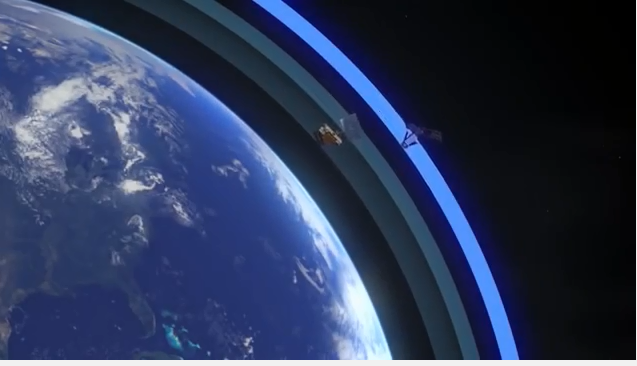
For each slot swap, a new satellite is placed near an existing satellite (about 50 km apart). Our engineers then instantaneously move the communication cross-links to the new satellite and drop the old links on the legacy satellite. The legacy satellite is then physical lowered into a temporary storage orbit for eventual de-orbit.
“One of the biggest challenges we have to do is a slot swap. We have satellites moving at 7.4 kilometers per second, or 16,700 mph, and we are actually rendezvousing these satellites every time we do a slot swap,” said Chris Jones, Director Mission Operations, Iridium. “It’s like a delicate dance we do. As you’re doing that, you also have to maintain service, so you take one satellite in and one out without impacting the user.”
The scale of this process is unprecedented. For a constellation like Iridium’s, a slot swap occurs each time a new satellite replaces an old one until all 66 operational Iridium NEXT satellites are placed into service, completing the largest tech refresh in space. Meanwhile, the Iridium NEXT satellites are backwards compatible and fully the legacy services, in addition to enabling new services, such as Iridium CertusSM.
Stay tuned for more information on the Iridium NEXT program here at Iridium360 and on Iridium’s social pages – Twitter – Facebook – LinkedIn. To learn more about Iridium NEXT and the ground-breaking new capabilities it will enable, please visit www.iridiumnext.com.
Today, the polar regions are still considered uncharted territory by most people. But, for the adventure traveler community, this region is considered the next frontier and their next conquest. One man in particular has taken his knack for innovation, thirst for adventure and humanitarian drive to the next level by creating the Outer Edge Polar Challenge Ride for Leukemia. Iridium is honored to have played a role in supporting this challenge with our partner, Beam Communications.
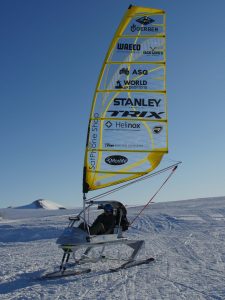
Charles Werb, the founder of the Outer Edge Polar Challenge Ride for Leukemia, developed a one-of-a-kind wind-powered snow sailer, designed to glide across the ice at speeds up to 60 miles per hour. He is the first person to create a vehicle of this kind, and sail across the Polar Plateau, which is a large area in Eastern Anarctica that spans a diameter of approximately 620 miles. His initiative has a clear set of goals in mind, which are to prove that snow/ice sailing is a viable and environmentally friendly means of transportation in the Antarctic, raise awareness and funds for leukemia research, gain scientific insight into the polar environment and climate to enhance STEM programs in Australia, and challenge current world records. Prior to starting his expedition, he was inspired to raise funds for the Leukemia Foundation of Australia, after the passing of his father, Henry Werb. Thus, the Outer Edge Polar Challenge Ride for Leukemia was born.
As one can imagine, sailing on ice, across the Polar Plate, was a daunting task and required a dedicated team to support such a treacherous and unpredictable environment. According to Charles, the first expedition had its fair share of obstacles to overcome, between arriving three days late, experiencing technical issues with the snow sailer, and just the overall difficulties the Antarctic climate presents. But, the one part of his trip that was not compromised was the communications infrastructure for him and his team.
In order to remain in touch with everyone involved, Werb and his crew had an Iridium GO!® and an Iridium Extreme® satellite phone on hand. Both devices are enabled by the Iridium network, the only commercial mobile satellite constellation that enables communications in the poles today. Charles said, “It’s incredible to think that I was able to use my smartphone to capture images without going through all of the download processes. I connected directly to my Iridium GO! and was able to broadcast directly from Antarctica.”
Additionally, by using the Iridium Extreme handset, the group was always connected, and able to place calls for help when needed. Not only did these devices ensure that nobody ever felt disconnected, but they increased the trip’s efficiency, and most importantly, the safety of the expedition. When asked if he would recommend Iridium-enabled products to fellow Polar adventurers, Charles’s answer was, “Absolutely; without a doubt.”
If you are interested in staying up-to-date on all things surrounding Charles and the Outer Edge adventures, please visit http://outeredgemag.com.au/outer-edge-expeditions/. Charles will be competing in the World ice and snow Sailing championships in Tolyatti, Russia from 21-26 February 2017, as well as making an attempt to snowsail on the Volga River for 24 hours with his new SWOOSH snowailer. The event can be tracked on this website through his Iridium GO! device.
Lastly, if you are looking for information about Iridium products for your next adventure, everything you need to know can be found at https://www.iridium.com/products.
You are currently browsing the IFP blog archives for February, 2017.

 snow sailer, designed to glide across the ice at speeds up to 60 miles per hour. He is the first person to create a vehicle of this kind, and sail across the Polar Plateau, which is a large area in Eastern Anarctica that spans a diameter of approximately 620 miles. His initiative has a clear set of goals in mind, which are to prove that snow/ice sailing is a viable and environmentally friendly means of transportation in the Antarctic, raise awareness and funds for leukemia research, gain scientific insight into the polar environment and climate to enhance STEM programs in Australia, and challenge current world records. Prior to starting his expedition, he was inspired to raise funds for the Leukemia Foundation of Australia, after the passing of his father, Henry Werb. Thus, the Outer Edge Polar Challenge Ride for Leukemia was born.
 In order to remain in touch with everyone involved, Werb and his crew had an